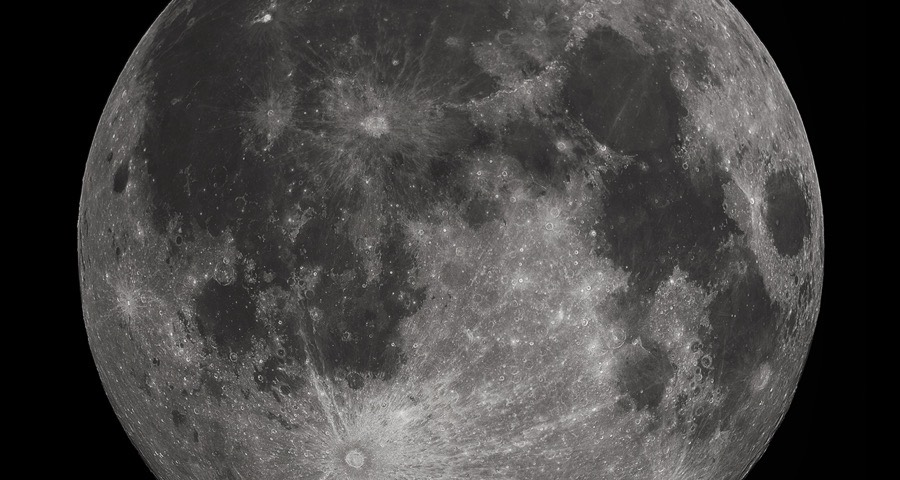
The Moon
The only other world a human being has ever set foot on — and likely the result of a cataclysmic collision that occurred in Earth's earliest moments.
Born of a giant collision
The most solidly established hypothesis for the Moon's origin, the giant-impact hypothesis, proposes that it formed about 4.5 billion years ago, when a Mars-sized object, sometimes nicknamed Theia, collided with the still-young Earth. The impact is thought to have vaporized a huge amount of material, flung into orbit around Earth, which then gradually clumped together to form the Moon — a process that, according to simulations, may have taken only a few decades to a few centuries.
This hypothesis elegantly explains several observations: the Moon's chemical composition, very close to Earth's mantle but depleted in volatile elements that would have evaporated during the impact, and the near-total absence of iron in its core, since Theia's iron had likely already sunk into Earth's core before the collision.
A gravitational bond that shapes both worlds
The Moon is locked in synchronous rotation with Earth: it takes exactly the same amount of time to rotate once on its axis as it does to complete one orbit around Earth, about 27.3 days. That's why it always shows us the same face — not because it doesn't rotate, but because its rotation and revolution are perfectly synchronized, an equilibrium reached after millions of years of tidal friction.
The Moon's far side, completely unknown until the first images sent back by a Soviet probe in 1959, has a surface strikingly different from the near side: far more heavily cratered, and nearly devoid of the large dark plains called lunar maria that dominate the face we see from Earth — an asymmetry whose exact cause remains debated.
The lunar phases
The phases of the Moon simply result from the changing angle between the Sun, Earth, and the Moon over the course of its monthly orbit — the Moon itself never changes, only the portion of its lit face visible from Earth varies. At new moon, the lit face is turned entirely toward the Sun, away from Earth, making the Moon invisible; at full moon, Earth lies between the Sun and the Moon, whose entire face turned toward us is then lit up. In between, the Moon goes through a complete cycle of 29.5 days — the synodic month — slightly longer than its actual orbital period of 27.3 days, because Earth itself moves around the Sun during that time.
The Apollo missions
Between 1969 and 1972, NASA's Apollo program landed twelve astronauts on the lunar surface across six successful missions, beginning with Apollo 11 and Neil Armstrong and Buzz Aldrin's first steps in July 1969. These missions brought back about 382 kilograms of lunar rock and soil samples, still studied today, and left behind laser reflectors that still make it possible to measure the Earth-Moon distance to within a few centimeters by timing the round trip of a laser beam.
More than half a century later, several space agencies and private companies are preparing a human return to the Moon, notably through NASA's Artemis program, aiming this time to establish a lasting presence, particularly near the lunar south pole, where permanently shadowed craters may harbor water ice.
"Earthrise"
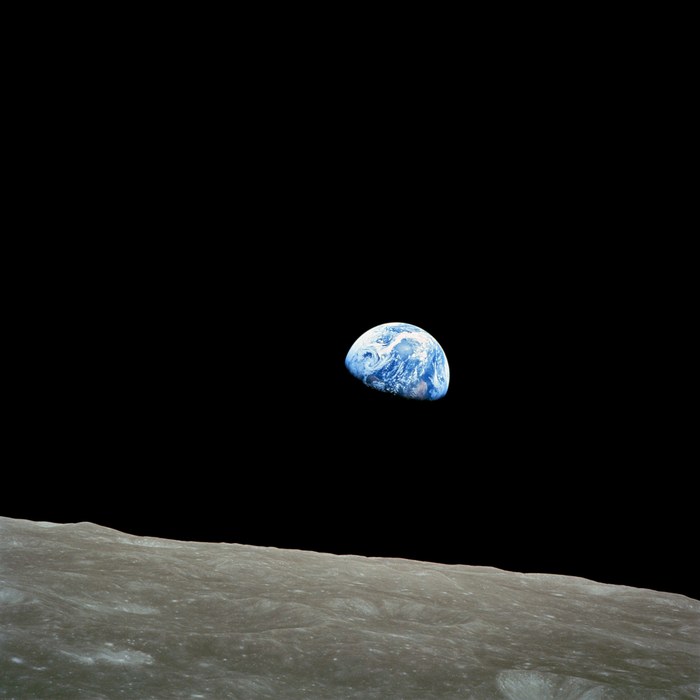
This photograph, taken on December 24, 1968, by astronaut Bill Anders from the Apollo 8 capsule — the first crewed mission to orbit the Moon, three years before Apollo 11 — has become one of the most famous images ever taken. Anders captured it almost by surprise, hastily switching lenses as Earth appeared above the lunar horizon during the capsule's fourth orbit.
Nicknamed Earthrise, this image left a deep mark on the public perception of our planet: for the first time, humanity saw the whole Earth as a small, isolated, fragile blue world, suspended in the void above a gray, lifeless lunar landscape. It is widely credited today with helping spark the environmental movement that emerged in the late 1960s.
A Moon that's drifting away
The Moon is moving away from Earth at a measurable rate of about 3.8 centimeters per year, a direct consequence of the tidal energy exchange between the two bodies: the Moon very slightly slows Earth's rotation, which in turn transfers angular momentum to the Moon's orbit, gradually pushing it farther out. About 620 million years ago, the Moon was close enough that an Earth day lasted only about 21 hours.
This ongoing drift has a direct and unavoidable consequence for the future of total solar eclipses: in several hundred million years, the Moon will appear too small in the sky to fully cover the solar disk, and only annular eclipses will remain possible.
To photograph the Moon yourself
A simple smartphone paired with the right adapter is enough to capture striking photos of the Moon — our guide details what you'll need.
How to photograph the Moon and planets →