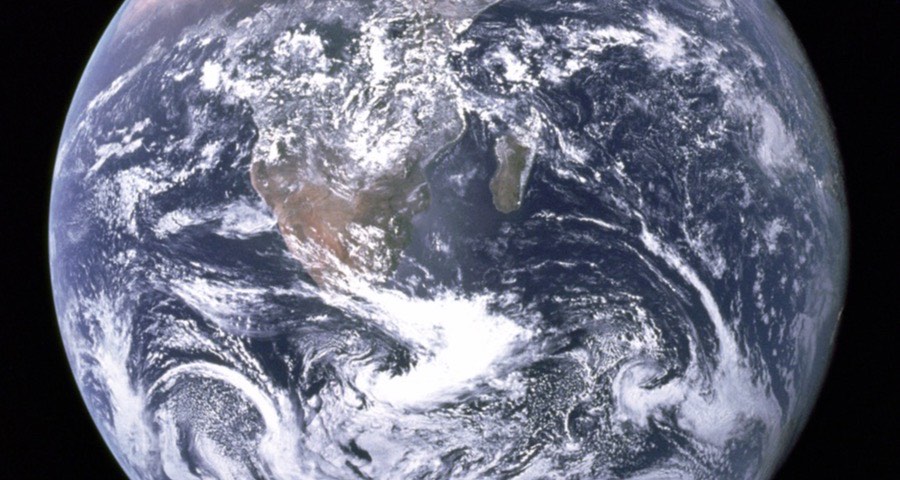
Earth
The only planet in the solar system — and, so far, in the entire known universe — where life exists. A combination of chance and balance that has proven hard to find anywhere else.
Internal structure
Beneath our feet, Earth is organized into concentric layers. The crust, thin and rigid (5 to 70 km thick depending on location), floats on a viscous rocky mantle that extends down to 2,900 km, whose very slow convection currents drive plate tectonics. Next comes the outer core, a layer of molten iron and nickel, then the inner core, solid despite a temperature comparable to the Sun's surface, kept solid by immense pressure.
It is precisely the motion of liquid iron in the outer core, combined with the planet's rotation, that generates Earth's magnetic field through a mechanism called the dynamo effect.
Systems
Earth's atmosphere (78% nitrogen, 21% oxygen) is unique among the planets of the solar system: its oxygen is almost entirely of biological origin, produced by billions of years of photosynthesis. The magnetosphere, generated by the core, deflects most of the solar wind and dangerous cosmic particles, an invisible shield without which the atmosphere itself would probably have been stripped away over time, as appears to have happened to Mars.
The water cycle — evaporation, condensation, precipitation — continuously redistributes water between oceans, atmosphere, and continents, regulating the climate and making the surface habitable across nearly the entire planet.
The Van Allen belts and the auroras
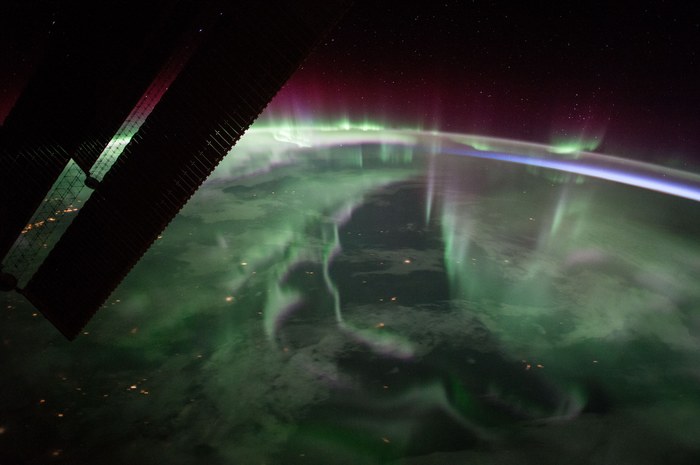
Earth's magnetosphere traps some of the solar wind's charged particles in two vast, torus-shaped rings called the Van Allen belts, discovered in 1958 thanks to the very first American satellite, Explorer 1. The inner belt, rich in energetic protons, and the outer belt, dominated by electrons, extend respectively between about 1,000 and 60,000 km in altitude — a region crewed spacecraft must pass through quickly, with the Apollo astronauts remaining the most notable exception to have done so.
At polar latitudes, some of these particles escape along the magnetic field lines and collide with molecules in the upper atmosphere, producing the polar auroras — green for oxygen, purple or bluish for nitrogen. Photographed here from the International Space Station, they are visible to the naked eye only on clear nights, far from any light pollution, and especially during periods of high solar activity.
Natural satellite
The Moon, likely born from a collision between the young Earth and a Mars-sized body about 4.5 billion years ago, is unusually large relative to its planet — a quarter of Earth's diameter, a ratio unique among the terrestrial planets. Its presence stabilizes the tilt of Earth's axis over long timescales, preventing chaotic climate swings.
The Moon's gravitational pull (and, to a lesser extent, the Sun's) is also responsible for ocean tides, a phenomenon that very slightly slows Earth's rotation over millennia — the Moon, in turn, drifts away by about 3.8 cm per year.
A planet always in motion
The tectonic plates that make up Earth's crust are constantly drifting, by a few centimeters a year — roughly the speed at which fingernails grow. This motion, invisible on the scale of a human lifetime, reshapes the planet's geography over tens of millions of years: today's continents have assembled and split apart multiple times throughout Earth's history, forming supercontinents such as Pangaea in turn.
Geological models predict that a new supercontinent, sometimes nicknamed Pangaea Ultima, could form in about 250 million years — a future so distant that the Sun itself will have noticeably evolved by then.
A planet under constant watch
Unlike other planets, Earth doesn't need a distant probe to be studied: hundreds of observation satellites monitor it continuously, measuring temperature, ocean levels, ice caps, and atmospheric composition. The International Space Station (ISS), continuously inhabited since 2000, offers a unique observation post over our own planet from low orbit.
This constant monitoring makes Earth the best-documented celestial body in the solar system — invaluable data for understanding its evolution, and by comparison, that of other terrestrial planets such as Venus and Mars.
The origins of life
The oldest traces of life on Earth date back about 3.5 to 3.8 billion years — barely a few hundred million years after the end of the late heavy bombardment that pelted the inner solar system with meteorites. For nearly 3 billion years, this life remained exclusively microbial: it was cyanobacteria that, by releasing oxygen through photosynthesis, gradually transformed Earth's atmosphere during the "Great Oxidation Event," about 2.4 billion years ago.
Complex, multicellular life truly appears only with the Cambrian explosion, about 540 million years ago — a sudden and still partly mysterious diversification of animal life forms, giving rise to nearly all the major groups that inhabit Earth today.
An atmosphere changing fast
Since the start of the industrial era, atmospheric CO₂ concentration has risen from about 280 to more than 420 parts per million — a rapid increase on a geological timescale, entirely attributable to human activity (burning fossil fuels, deforestation). This buildup strengthens the planet's natural greenhouse effect, driving global warming that is measured and documented by the same satellites that continuously monitor the state of the Earth.
Understanding this rapid change relies directly on comparative study of the other planets: Venus illustrates an extreme runaway greenhouse effect, while Mars shows what happens to a world that has lost its atmosphere — two reference points that help gauge the scale and stakes of the changes now underway on Earth.