
Asterisms
Star patterns that everyone recognizes without effort — and yet officially exist nowhere at all.
A popular shape, not an official map
An asterism is a group of stars that is easily recognizable in the sky, but has no official status in astronomy. Unlike the 88 constellations recognized by the International Astronomical Union, an asterism has no defined boundaries and covers no portion of the sky: it is simply a pattern, a shape the human eye latches onto — often long before anyone learns the formal name of the constellation that contains it.
The best-known example is the Big Dipper: the seven bright stars sometimes called "the Plough" or "the Wagon" are only a small part of the official constellation of Ursa Major, which contains many more stars. It is those seven stars, easy to spot at a glance, that form the asterism — the full constellation stretches far beyond it, with much fainter stars.
A few famous asterisms
The Summer Triangle is probably the easiest to spot: three very bright stars — Vega (in Lyra), Deneb (in Cygnus), and Altair (in Aquila) — that dominate the summer sky in the northern hemisphere, even though they belong to three different constellations.
Orion's Belt, three aligned and almost perfectly evenly spaced stars, is another striking example: on its own, it serves as a landmark for finding the much larger constellation of Orion, and even for extending an imaginary line all the way to Sirius, the brightest star in the night sky.
In the southern hemisphere, the Southern Cross — four main stars forming a cross shape — plays a role identical to that of the North Star in the northern hemisphere: extending its long axis points roughly toward the south celestial pole.
What are they actually used for?
Long before sky charts and mobile apps, these simple patterns served as genuine navigation tools. By extending the line formed by the two stars at the end of the Big Dipper's "bowl," you land directly on the North Star — the oldest and most reliable method for finding north in the northern hemisphere, without any instrument at all.
It is this practical usefulness, more than scientific rigor, that explains why asterisms have endured across cultures and centuries: they require no prior knowledge, just a clear sky and a few minutes of observation.
Asterisms at every scale
Some asterisms fit entirely within a single constellation, like Orion's Belt; others, like the Summer Triangle, connect stars belonging to completely different constellations, sometimes tens of degrees apart in the sky. There are also asterisms at a very small scale: the Pleiades, a naked-eye star cluster resembling a tiny dipper, are themselves sometimes nicknamed the "Seven Sisters," even though they are just one detail within the vast constellation of Taurus.
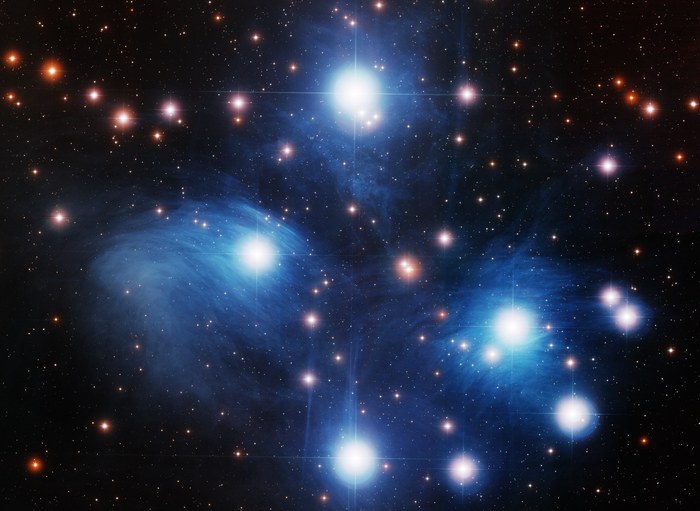
To the naked eye, most observers can only make out six or seven stars of the Pleiades clustered tightly together — hence the nickname "Seven Sisters," inherited from Greek mythology. This close-up image reveals a far richer reality: the cluster actually contains several hundred stars, all born together barely a hundred million years ago, and the brightest of them are still bathed in a cloud of gas and dust that reflects their bluish light — a nebulosity that, by pure coincidence, has no connection to the formation of these stars, the cluster simply passing through an unrelated interstellar cloud along its current path.
Visible to the naked eye from practically every inhabited point on the globe, the Pleiades rank among the most universally recognized celestial objects across human cultures, far beyond the Western world: they are mentioned in texts as ancient and far-flung as Australian Aboriginal mythology, ancient Greek agricultural calendars, and Polynesian navigation lore.
The Great Square of Pegasus
The Great Square of Pegasus, four stars forming a vast, nearly perfect quadrilateral, is another valuable landmark in late summer and autumn in the northern hemisphere: its regularity makes it a convenient starting point for navigating toward neighboring constellations, including Andromeda and its famous galaxy.
The same sky, different shapes depending on the culture
Western asterisms are just one way among many of connecting the same points of light. Traditional Chinese astronomers divided the sky into 283 distinct star groups, organized around the celestial emperor rather than the Greco-Roman mythological figures. Polynesian navigators, for their part, memorized lines of stars rising and setting at precise points on the horizon, a system entirely designed for open-ocean navigation without instruments, which allowed them to cross the Pacific long before the age of Western nautical charts.
This diversity is a simple reminder: the starry sky itself "contains" no shapes at all — it is human cultures that, by connecting the same points with different lines, have projected onto it their own stories, landmarks, and survival tools, each in their own way.
Spotting asterisms more easily
Most asterisms are already visible to the naked eye, but a pair of binoculars often reveals details you'd otherwise miss — double stars, tight clusters — without leaving your backyard.
Best astronomy binoculars for beginners →