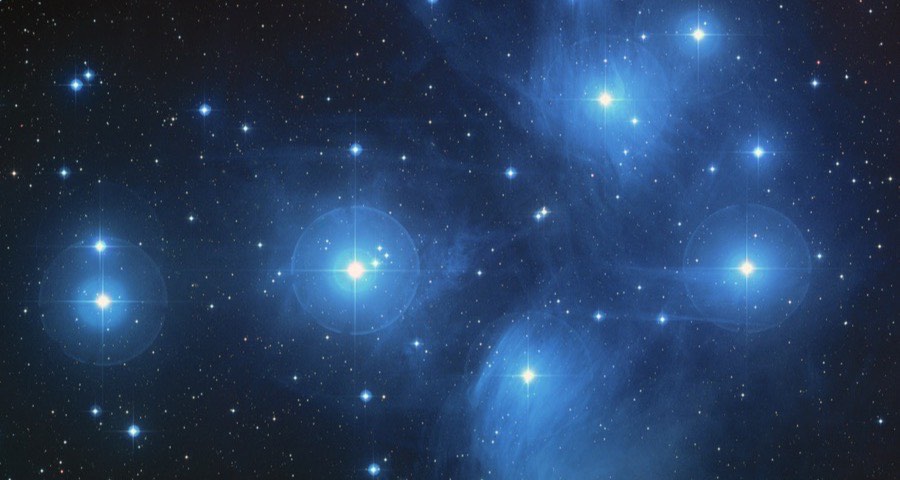
Stars
The Sun looks huge and unique from Earth. Seen from the galaxy, it's a perfectly ordinary star among hundreds of billions of others.
The Sun, an average star
Our galaxy, the Milky Way, is thought to contain between 100 and 400 billion stars — and the observable universe, hundreds of billions of galaxies like our own. Within this immense population, the Sun is nothing exceptional: not especially big, not especially hot, not especially old. That is precisely what makes it such a valuable case study: to understand the Sun is to understand how a "typical" star works.
Spectral classification
Astronomers classify stars by their surface temperature and color, using a sequence of letters that remains historical and far from intuitive: O, B, A, F, G, K, M, from the hottest (blue, over 30,000°C at the surface) to the coolest (red, around 3,000°C). The Sun is a type G yellow dwarf, with a surface temperature of about 5,500°C — literally in the middle of the scale.
This classification is combined with a star's luminosity to form the Hertzsprung-Russell diagram, one of the most widely used tools in astrophysics: it makes it possible to see at a glance where a star stands in its life, between the main sequence (where the Sun spends most of its life), the giants, and the dwarfs.
A life cycle that depends on mass
All stars are born the same way: the collapse of a cloud of gas and dust under its own gravity, until the pressure and temperature at its center trigger the nuclear fusion of hydrogen. This stage, called the main sequence, occupies the largest part of a star's life — about 10 billion years for a star like the Sun, currently 4.6 billion years old, and so roughly halfway through.
What follows depends almost entirely on the star's initial mass. A star like the Sun, once its hydrogen is exhausted, will swell into a red giant — large enough to engulf Mercury and Venus — before expelling its outer layers and leaving behind a compact, extremely dense core: a white dwarf, which will then cool for billions of years without ever fully going dark.
Far more massive stars meet a much more violent end: after a much shorter and more intense existence, they collapse in a fraction of a second and then explode as a supernova, one of the most luminous events in the universe. What remains of their core becomes, depending on the leftover mass, an extraordinarily dense neutron star, or a black hole from which not even light can escape.
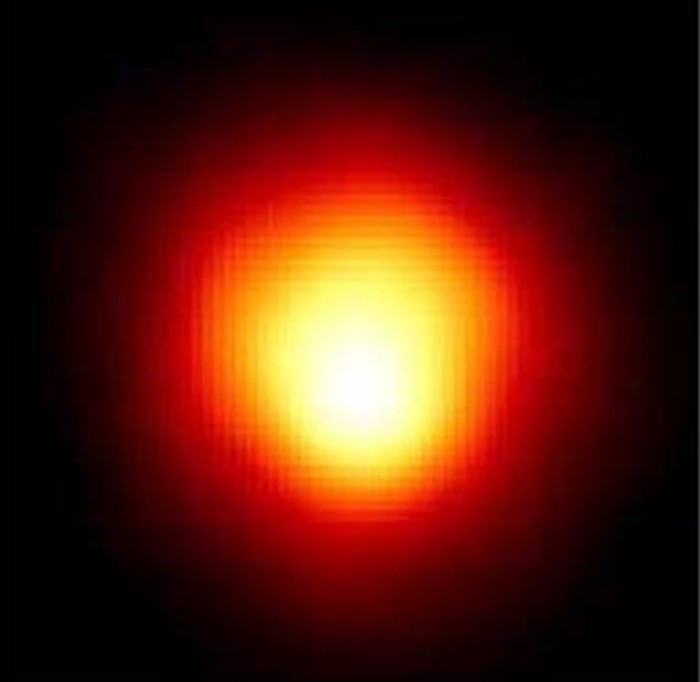
This image, captured by the Hubble Space Telescope, remains a historic one: it is the very first direct photograph of the surface of a star other than the Sun, since every other star remains a mere point of light even through the largest telescopes, owing to its overwhelming distance. It shows Betelgeuse, a red supergiant in the constellation Orion so vast that, placed at the Sun's position, its surface would engulf all the planets out to roughly Jupiter.
Betelgeuse has already entered the final stages of its life and could explode as a supernova at any moment on an astronomical timescale — which, in practice, means anywhere between tomorrow and several hundred thousand years from now, an uncertainty that doesn't stop astronomers from closely monitoring its brightness variations, as during the mysterious "Great Dimming" of 2019-2020, caused by a huge cloud of dust ejected by the star itself. When the explosion happens, it will be visible in broad daylight from Earth for several weeks, without posing the slightest danger: Betelgeuse lies more than 500 light-years away, far beyond any distance that could affect our planet.
Distances beyond intuition
The star closest to the Sun, Proxima Centauri, lies about 4.2 light-years away — meaning its light, traveling at 300,000 km/s, takes more than four years to reach us. On Astrolab 3D's realistic scale, even Neptune, the most distant planet in the solar system, represents only a tiny fraction of that distance: a good way to grasp just how far away stars remain, even the closest ones, as neighbors.