
Comets
Blocks of ice from the far reaches of the solar system, silently blazing to life as they approach the Sun.
A "dirty snowball"
A comet is a small body made of ices (water, carbon dioxide, carbon monoxide), dust, and rock — a mixture that astronomer Fred Whipple once summed up in the now-famous phrase "dirty snowball." Its solid nucleus rarely measures more than a few kilometers across.
As long as it stays far from the Sun, a comet is a cold, inert, invisible object. Everything changes as it draws closer: the heat causes its ices to sublimate directly into gas, releasing a diffuse cloud of gas and dust called the coma, which can grow to a diameter larger than Earth's.
Two tails, always pointing away from the Sun
It is this cloud of gas and dust, pushed back by the solar wind and the pressure of sunlight, that forms a comet's famous tails — always pointing away from the Sun, regardless of the direction the comet itself is traveling. The dust tail, slightly curved, simply reflects sunlight. The ion tail, straight and often bluish, is made of ionized gas pushed directly by the solar wind.
NEOWISE, the great comet of 2020
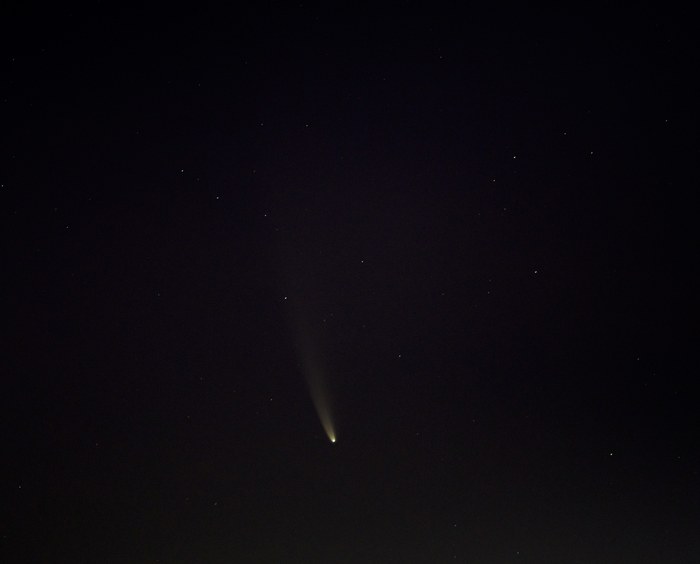
Discovered on March 27, 2020, by the NEOWISE space telescope (which it is named after), this comet became, to everyone's surprise, one of the most spectacular naked-eye celestial objects visible from the northern hemisphere in more than twenty years — the previous great, easily visible comet dating back to Hale-Bopp in 1997. Photographed here before dawn above Washington, it clearly shows its bright coma and the beginning of its curved dust tail, visible without any instrument to millions of people confined at home during the summer of 2020.
With an orbit of roughly 6,800 years, NEOWISE will not return to the Sun's neighborhood until around the year 8800 — so those who observed it in July 2020 witnessed a sight no human will see again for dozens of centuries. Its very survival during its close pass by the Sun was not guaranteed: many promising comets disintegrate under the Sun's heat before even reaching peak brightness, a risk regularly confirmed by history's great cometary disappointments.
Where do they come from?
Short-period comets, which pass close to the Sun again in less than 200 years, generally come from the Kuiper belt, beyond Neptune. Long-period comets come from infinitely farther away: the Oort cloud, a vast hypothetical spherical shell of icy bodies thought to surround the entire solar system, out to a light-year from the Sun.
The most famous of all, Halley's Comet, becomes visible from Earth again roughly every 76 years — its last pass was in 1986, and the next is expected in 2061. Others, such as Hale-Bopp (1997) or NEOWISE (2020), remained visible to the naked eye for several weeks.
Landing on a comet
In 2014, the European probe Rosetta achieved a historic first by entering orbit around comet 67P/Churyumov-Gerasimenko, before releasing the small lander Philae onto its surface — the very first controlled landing on a comet's nucleus. The mission confirmed that comets are among the most primitive objects in the solar system, virtually unchanged since its formation.
How a comet gets its name
A comet is traditionally named after its discoverer or discoverers — a tradition dating back to the 18th century that explains names like Hale-Bopp (discovered independently by two American amateur astronomers, Alan Hale and Thomas Bopp, on the same night in 1995) or Shoemaker-Levy 9. Many comets today are discovered by automated sky-survey programs rather than by individuals, which produces more technical designations like NEOWISE, named after the space telescope that spotted it.
The official designation follows a precise international code: a letter indicating the orbit type (P for periodic, C for non-periodic, D for disappeared or disintegrated), followed by the year of discovery and an alphanumeric order. Halley's Comet thus carries the official designation 1P/Halley — the "1P" meaning it was historically the very first comet identified as periodic.
A blurrier boundary than it seems
The distinction between comets and asteroids, long considered clear-cut, has blurred with the discovery of several hybrid objects. Some bodies in the main asteroid belt occasionally develop a temporary coma, just like a classic comet — these are called active asteroids, or main-belt comets. Conversely, some old comets, after many passes near the Sun, exhaust all their surface ices and end up looking indistinguishable from inert rocky asteroids.
Some comets do not survive their own passage: in 1994, the comet Shoemaker-Levy 9, fragmented by Jupiter's tidal forces during an earlier pass, broke apart into about twenty pieces that struck the giant planet one after another, watched by telescopes around the world — the first cometary impact ever observed live in the solar system.
Spotting a comet from your backyard
Most naked-eye-visible comets are much easier to spot with binoculars, thanks to their wide field of view — our guide helps you choose the right pair.
Best astronomy binoculars for beginners →