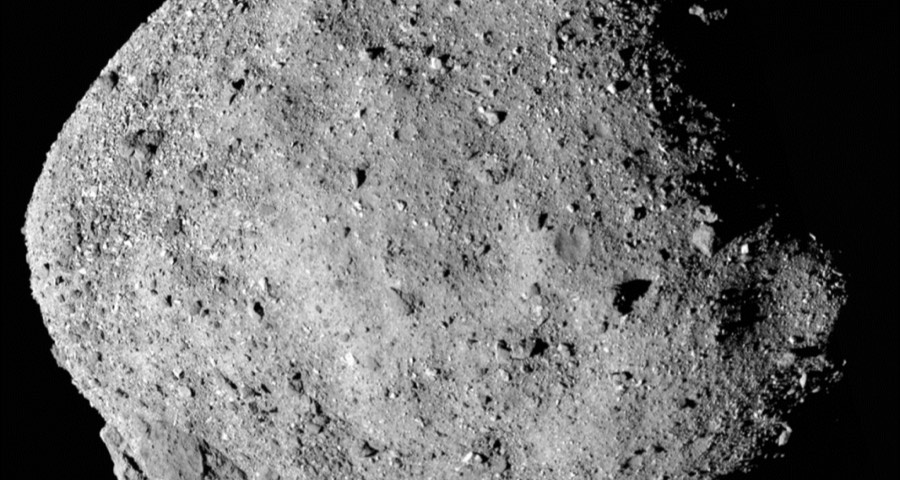
Asteroids
The leftovers from the solar system's formation — too numerous to count one by one, too small to be planets.
What never assembled into a planet
Asteroids are rocky or metallic bodies, ranging from a few meters to several hundred kilometers across, that orbit the Sun without ever reaching the mass or shape of a planet. There are several million of them, with the vast majority concentrated in the main belt, between the orbits of Mars and Jupiter — visible in Astrolab 3D as a ring of dust.
This belt is not the remnant of a destroyed planet, as popular culture long assumed: it is actually material that never managed to assemble into a single body. Jupiter's massive gravitational influence, so close by, constantly disturbed the debris' trajectories and kept it from clumping together peacefully.
Three main families
Asteroids are generally classified according to their composition, inferred from the light they reflect. C-type asteroids (carbonaceous) are the darkest and most numerous — about three-quarters of the known population — rich in primitive carbon compounds. S-type asteroids (silicaceous), lighter in color, are made of silicates and metals, and tend to sit in the inner part of the belt. M-type asteroids (metallic), rarer still, are suspected to be the metallic cores of larger ancient bodies, destroyed by collisions.
The most massive — Vesta, Pallas, and Hygiea — measure several hundred kilometers across. Ceres, the largest object in the belt, was in fact reclassified as a dwarf planet in 2006, alongside Pluto, because its gravity is enough to pull it into a spherical shape.
Near-Earth asteroids and planetary defense
Some asteroids, called near-Earth asteroids (NEAs), follow orbits that bring them close to Earth's own. These are the ones space agencies monitor as a priority, cataloguing their trajectories to rule out any long-term risk of collision.
In 2022, NASA's DART mission deliberately crashed into Dimorphos, the small moon of the asteroid Didymos, to test under real conditions our ability to deflect the trajectory of a dangerous object — the very first demonstration of active planetary defense.
The last image before impact
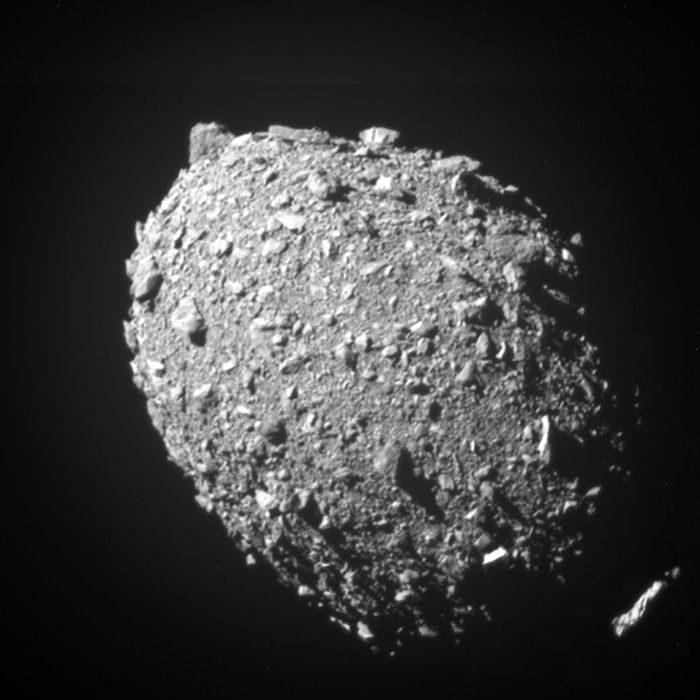
This photograph, transmitted by DART just two seconds before the impact on September 26, 2022, is the last one to show Dimorphos in its entirety — the following images, taken just a few hundred meters out, captured only a partial close-up of its surface before the signal was lost. It clearly shows a terrain littered with rocky boulders of every size, with no visible impact crater despite its apparently great age — a surface typical of the "rubble piles" that likely make up many small asteroids.
The impact, which occurred at over 22,000 km/h, shortened Dimorphos's orbital period around Didymos by about 32 minutes — a seemingly tiny change in trajectory, but far above the success threshold set for the mission, and much greater than initial models predicted. This excess is explained by the large quantity of debris ejected by the impact, which acted as extra propulsion — a crucial data point for calibrating a future mission to deflect a genuinely threatening asteroid.
Getting a closer look
Several probes have landed on, or collected samples from, asteroids: Hayabusa2 (the Japanese agency JAXA) brought fragments of the asteroid Ryugu back to Earth, while OSIRIS-REx (NASA) did the same with Bennu. The Dawn mission, meanwhile, orbited Vesta and then Ceres in succession — the first probe ever to visit two different bodies in the solar system.
Jupiter's Trojan asteroids
Not all asteroids sit in the main belt. The Trojan asteroids share Jupiter's orbit around the Sun, grouped into two stable swarms located 60° ahead of and 60° behind the planet — gravitational equilibrium points called the L4 and L5 Lagrange points, where the pull of the Sun and Jupiter combine to trap these objects permanently. Their total number is estimated at several million, potentially as many as in the main belt.
Launched in 2021, NASA's Lucy probe is the first mission dedicated to exploring them: its trajectory, one of the most complex ever designed, is set to let it fly past one main-belt asteroid and then eight different Trojan asteroids by 2033, offering a comparative look at these relics, considered near-pristine witnesses to the solar system's earliest days.