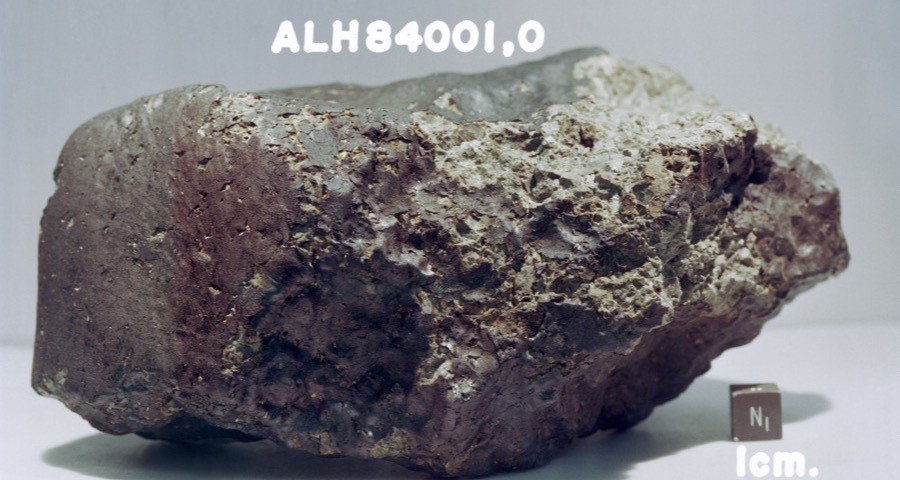
Meteorites
Three words for the same rock, depending on exactly where you encounter it: in space, in the sky, or in your hands.
Meteoroid, meteor, meteorite
These three terms actually describe three stages of the same journey. A meteoroid is a small fragment of rock or metal, often no bigger than a pebble, drifting freely through space. When it enters Earth's atmosphere at very high speed and heats up from friction until it glows, it's called a meteor — the "shooting star" briefly glimpsed in the night sky. If it doesn't burn up completely and a fragment reaches the ground, that fragment becomes a meteorite.
Nearly all meteoroids burn up entirely before reaching the ground; only a tiny fraction survives long enough to become an actual meteorite.
Three major families
Chondrites, stony meteorites, make up the vast majority of meteorites found on Earth. They take their name from chondrules, tiny frozen mineral spheres that date back to the very formation of the solar system, more than 4.5 billion years ago — they rank among the oldest and best-preserved objects that can be studied in a laboratory. Iron meteorites, made almost entirely of an iron-nickel alloy, are thought to come from the cores of very ancient differentiated asteroids destroyed by collisions. Stony-iron meteorites, rarer still, blend the two: a metallic network embedding mineral crystals, as in the famous pallasites.
A few meteorites, rarer still, come directly from the Moon or even Mars — blasted into space by a violent impact before ending their journey on Earth millions of years later.
When impact changes everything
Most falls go unnoticed, but some have made history. The Chicxulub crater, in Mexico, corresponds to the impact of an asteroid about 10 kilometers across that occurred 66 million years ago — the event most often linked to the extinction of the non-avian dinosaurs. More recently, in 2013, the Chelyabinsk meteor, in Russia, exploded in the atmosphere with an energy equivalent to several hundred kilotons of TNT, injuring more than a thousand people — almost entirely from the shockwave shattering windows, without any large fragment ever striking anyone.
The largest meteorite ever found intact, Hoba, in Namibia, weighs about 60 tonnes and has never been moved since its discovery: it still lies exactly where it fell.
The Chelyabinsk trail
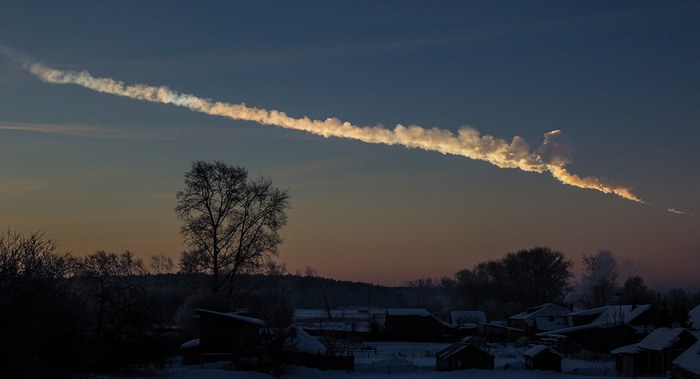
On February 15, 2013, an asteroid about 20 meters across entered the atmosphere above Russia's Chelyabinsk region at more than 60,000 km/h, far faster than an ordinary spacecraft reentry. It exploded in mid-air at an altitude of about 30 km, releasing an estimated energy of nearly 30 times that of the Hiroshima bomb and leaving this smoke and dust trail across the morning sky, visible for several minutes and photographed by thousands of dashcams and onlookers across the city.
This event remains the largest of its kind observed since the Tunguska explosion of 1908, and the only one ever to cause casualties directly linked to a documented impact: about 1,500 people were injured, nearly all by glass shards thrown when the shockwave shattered windows in nearby buildings a few minutes after the fireball passed. The event served as a wake-up call for the planetary defense community, since an object of this size, too small to be detected by most surveillance systems of the time, had not been spotted by any telescope before entering the atmosphere.
Where and how they're found
Meteorites statistically fall in roughly equal numbers across the entire surface of the globe, but they aren't found everywhere with the same ease: it takes terrain where a dark, foreign rock stands out clearly from its surroundings, and where it doesn't weather away too fast. Hot deserts (the Sahara, the Arabian Peninsula) and especially Antarctica are researchers' favorite hunting grounds: against the pristine blue ice of the southern continent, a dark meteorite can be spotted from dozens of meters away, and the extreme cold considerably limits its weathering since it fell, sometimes tens of thousands of years earlier.
These methodical polar expeditions are what has allowed the collection of the vast majority of the Martian and lunar meteorites known to date — samples that would otherwise be far more costly to bring back directly via a space mission.
Messengers from the solar system's past
Beyond their spectacular appeal, meteorites are a scientific tool of the first order. Chondrites, having remained virtually unchanged for 4.5 billion years, make it possible to precisely date the age of the solar system and reconstruct the original chemical composition of the cloud of gas and dust it was born from — information impossible to obtain by observing the Sun or the planets, whose matter has been profoundly transformed since their formation.
Some carbonaceous meteorites even contain complex organic molecules, including amino acids, which feeds the hypothesis that meteorite bombardments during Earth's youth may have delivered some of the chemical building blocks needed for life to appear.