Astrobiology and Extraterrestrial Life
Are we alone in the universe? Astrobiology is the science that takes this question seriously — without having answered it yet.
A science without a single confirmed object of study — yet
Astrobiology occupies a singular position among the sciences: it studies the conditions under which life can arise and survive in the universe, without having, to this day, a single confirmed example of extraterrestrial life to analyze. The field therefore rests on three pillars: understanding how life arose on Earth, identifying the limits of what life can tolerate, and actively searching for traces of life elsewhere — whether in the solar system or around distant stars.
Extremophiles broaden the realm of the possible
On Earth, the discovery of organisms called extremophiles has considerably broadened our idea of what life can tolerate. Some bacteria thrive in the boiling water of underwater hydrothermal vents, at temperatures over 100°C and under crushing pressure, with no sunlight at all, drawing their energy from chemical reactions rather than photosynthesis. Others survive in Antarctic ice, in concentrated acid, or even directly exposed to the vacuum of space and cosmic radiation, like tardigrades.
These discoveries directly inspired the search for life elsewhere: if life on Earth can thrive without sunlight near hydrothermal vents, why not in the subsurface ocean of an icy moon, warmed not by the Sun but by tidal forces?
The hidden oceans of Europa and Enceladus
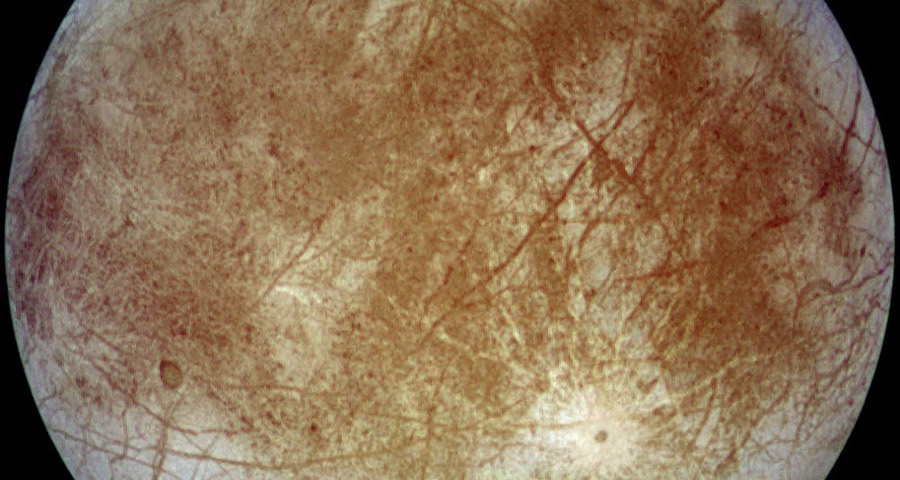
Europa, one of Jupiter's large moons, hides beneath its icy crust a salty liquid-water ocean that could hold twice as much water as all of Earth's oceans combined — kept liquid not by the Sun's heat, very weak at that distance, but by the warming produced by tidal forces from Jupiter's enormous gravity. NASA's Europa Clipper mission, launched in 2024, is set to study this ocean more closely during repeated flybys starting in 2030.
Enceladus, a small moon of Saturn, has delivered even more direct proof: in 2005, the Cassini probe flew through plumes of water vapor and ice particles erupting from fractures at its south pole, coming directly from its subsurface ocean, and detected complex organic molecules along with molecular hydrogen there — a possible sign of active chemical reactions at the bottom of that ocean, similar to those that sustain extremophiles on Earth.
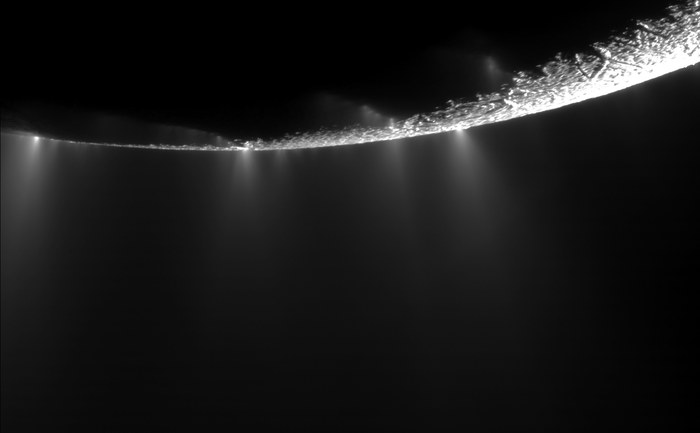
Backlit here by the Sun, these jets of ice erupt from the "tiger stripes," long parallel fractures that streak Enceladus's south pole — the Cassini probe directly flew through some of these plumes on several occasions between 2005 and 2015, sampling their composition with its onboard instruments without ever landing. These geysers continuously feed one of Saturn's rings, the E ring, made up entirely of ice particles ejected by this small moon.
The heat needed to keep the ocean beneath Enceladus's frozen crust liquid comes from tidal heating: Saturn's gravitational pull, combined with an orbital resonance with the neighboring moon Dione, continually stretches and squeezes Enceladus's interior, generating enough friction to keep the water from freezing solid despite its extreme distance from the Sun — a mechanism shared with Europa, and one that makes these icy moons priority targets that are far more accessible to study than the deep waters of an Earthly ocean.
The Fermi paradox
If life, and even intelligence, are statistically likely across a galaxy containing hundreds of billions of stars, why haven't we yet detected a single sign of an extraterrestrial civilization? This apparent contradiction, formulated by physicist Enrico Fermi in 1950, is known as the Fermi paradox. Proposed explanations range from the mundane — interstellar distances are so vast that communication or travel remains impractical — to the speculative: complex life could be extraordinarily rare, or technological civilizations might systematically destroy themselves before they can make their presence known on a large scale.
The SETI program (Search for Extraterrestrial Intelligence) has scanned the sky since the 1960s for artificial radio signals that would betray a technological civilization, without confirmed success to date.
Searching for biosignatures in distant atmospheres
Rather than searching for intelligence, the most active approach today consists of looking for biosignatures: chemical combinations in an exoplanet's atmosphere that would be difficult to explain without a biological process — for example, the coexistence of oxygen and methane, two gases that react quickly with one another and must therefore be continuously replenished to remain detectable together. The James Webb space telescope, by analyzing starlight filtered through the atmosphere of transiting exoplanets, is only just beginning to probe these distant atmospheres with unprecedented precision.