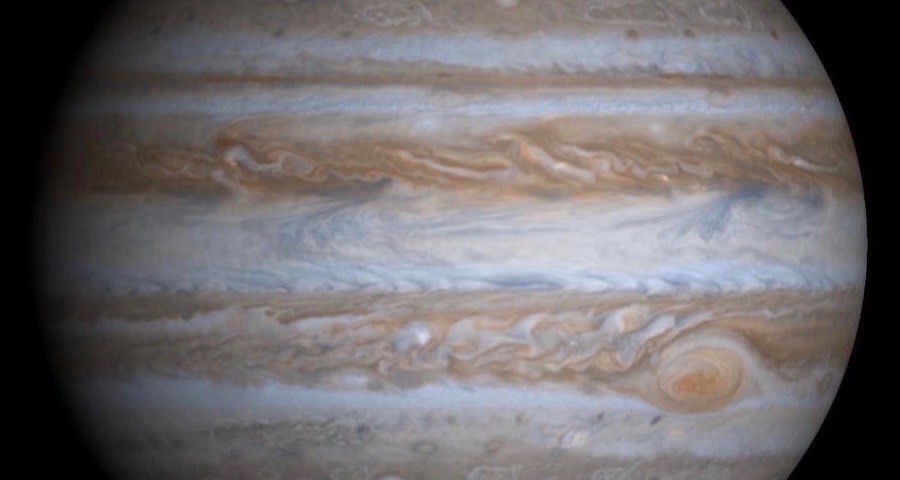
Jupiter
The largest planet in the solar system, so massive that it influences the orbits of all its neighbors — and hosts an entire mini-system of more than 90 moons on its own.
Physical characteristics
Jupiter is a gas giant made up of more than 90% hydrogen and helium, with no solid surface to speak of: beneath its colorful clouds, pressure builds so quickly that the gas gradually compresses into an ocean of liquid hydrogen, and then, deeper still, into conductive metallic hydrogen. Its mass alone exceeds 2.5 times that of all the other planets in the solar system combined.
The Great Red Spot, an anticyclonic storm observed since at least the 19th century, is large enough to swallow several Earths — though it has shrunk noticeably over recent decades, without any predictable date for its complete disappearance.
The Great Red Spot up close
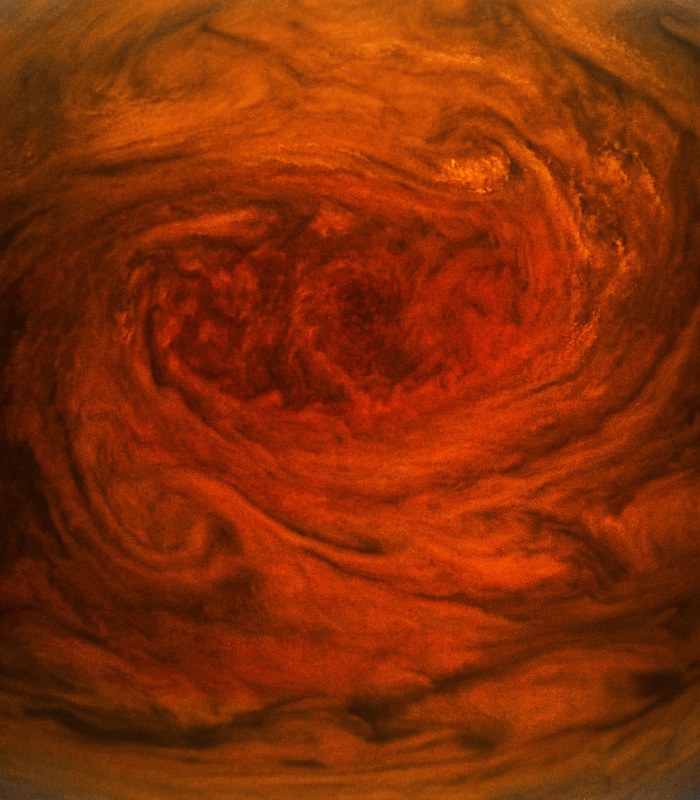
This close-up image, taken by the Juno probe during a low-altitude flyby and processed in enhanced color, reveals the complex swirling structure of the Great Red Spot: bands of clouds coiling around each other at speeds exceeding 400 km/h at its edges, surrounding a calmer core. Scientists believe its reddish hue comes from chemical compounds carried up from deeper atmospheric layers and transformed by the Sun's ultraviolet radiation, though their exact nature remains debated.
As large as Earth when it was first observed in detail in the 19th century, the storm has been shrinking steadily since the 1930s and today measures a little over one Earth-width across. Juno's measurements also show it is surprisingly shallow relative to its width: its roots reach only a few hundred kilometers into the atmosphere, a tiny fraction of the planet's total radius.
Moon system
Jupiter's four largest moons — Io, Europa, Ganymede, and Callisto — were discovered by Galileo as early as 1610, the first observational proof that not every celestial body orbited the Earth. Io is the most volcanically active body in the solar system, kept constantly heated by the gravitational friction of Jupiter and its neighboring moons. Europa, beneath a crust of ice, is thought to hide an ocean of liquid salty water in contact with a rocky core — one of the environments considered most promising for possible microbial life. Ganymede is the largest moon in the solar system, bigger even than Mercury.
Magnetic field and rings
Jupiter has the most powerful magnetic field of all the planets, generated by its rapidly rotating metallic hydrogen — the planet spins on its axis in under 10 hours despite its size. This field traps enormous quantities of charged particles in radiation belts that would make any prolonged human presence nearby extremely dangerous.
Jupiter also has a system of rings, far more tenuous and dark than Saturn's — made of fine dust likely produced by meteorite impacts on its small inner moons, invisible from Earth without specialized instruments.
Internal structure
Beneath Jupiter's clouds, pressure and temperature rise so rapidly that hydrogen changes state several times over: a gas near the surface, it becomes liquid a few thousand kilometers down, then, beyond about 20,000 km deep, turns into metallic hydrogen — a state of matter exceedingly rare on Earth, where electrons flow freely as in a conducting metal. It is the rapid rotation of this metallic ocean that generates the planet's colossal magnetic field.
Jupiter's center is thought to hold a partially dissolved core, larger and more diffuse than expected according to gravity measurements from the Juno probe — probably a few Earth masses' worth of rock and ice, gradually blended into the surrounding metallic hydrogen rather than sharply separated, as older models suggested.
A planet that radiates its own heat
Jupiter emits about 1.7 times more energy than it receives from the Sun — a heat surplus that comes mainly from its slow gravitational contraction since its formation, a process called the Kelvin-Helmholtz mechanism. This internal energy fuels remarkably violent weather: zonal winds exceeding 600 km/h stratify the atmosphere into light and dark bands clearly visible even with a small telescope.
Had Jupiter been about 80 times more massive, the pressure at its core would have been enough to trigger hydrogen nuclear fusion — it would then have become a star, forming a binary system with the Sun. Jupiter is nonetheless still sometimes nicknamed, a bit loosely, a "failed star."
Exploration
The Pioneer 10 and 11 probes (1973-1974) were the first to fly past Jupiter, followed by Voyager 1 and 2 in 1979, which revealed Io's active volcanism and the first close details of the Great Red Spot. The Galileo probe (1995-2003) was the first to enter orbit around Jupiter, releasing an atmospheric probe that directly measured the composition of Jovian clouds.
Since 2016, the Juno probe has been studying Jupiter's magnetic field, internal structure, and deep atmosphere in detail. The JUICE (ESA, launched 2023) and Europa Clipper (NASA, launched 2024) missions are currently en route to study the icy moons of the Jovian system up close, particularly Europa's potential ocean.
To observe Jupiter yourself
Jupiter's cloud bands and its four largest moons are visible with even a small telescope — our guide helps you choose the right instrument to get started.
Which telescope should you choose to get started? →