Exoplanets
Less than thirty years ago, we knew of no planets outside the solar system. Today, more than 5,000 have been confirmed, one by one.
A first step in 1995
An exoplanet is simply a planet that orbits a star other than the Sun. The first confirmed detection around a Sun-like star dates back to 1995: 51 Pegasi b, a giant gas planet orbiting so close to its star that its year lasts just four Earth days — a discovery so unexpected, a gas giant hugging its star, that it initially seemed to challenge models of planet formation. Its discoverers, Michel Mayor and Didier Queloz, received the Nobel Prize in Physics in 2019.
Since then, the pace of discoveries has accelerated considerably, driven in particular by dedicated space missions, to the point that confirmed exoplanets are now counted in the thousands.
How to detect an invisible world
The vast majority of exoplanets have been discovered using the transit method: when a planet passes in front of its star, as seen from Earth, it blocks a tiny fraction of its light — often less than 1% — in a perfectly periodic way. This is the method exploited by the Kepler space telescope, which continuously monitored the brightness of more than 150,000 stars for nearly a decade.
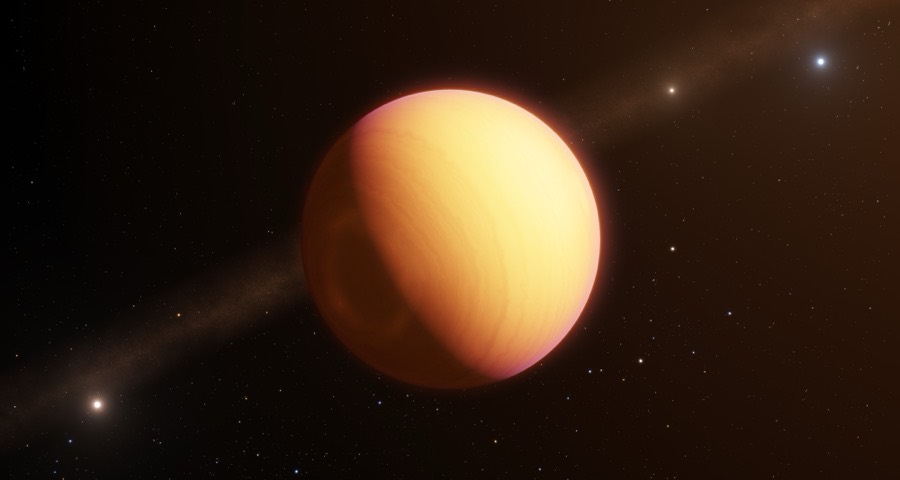
The radial velocity method, used for that very first detection in 1995, instead measures the very slight back-and-forth wobble of a star, tugged by the gravity of the planet orbiting it — a tiny but measurable effect in the spectrum of the star's light. More rarely, direct imaging manages to photograph the exoplanet itself, by blocking the dazzling light of its star: this is how the image of HR 8799e, a young giant planet still hot from its formation, shown above, was obtained.
The habitable zone
A significant share of exoplanet research aims to identify worlds located in the habitable zone of their star — the region where the temperature would allow water to exist in liquid form on the surface, neither too hot to evaporate nor too cold to freeze entirely. Being in this zone, however, guarantees nothing: Venus itself orbits at the inner edge of the Sun's habitable zone, and its atmosphere has made it one of the most hellish places in the solar system.
The TRAPPIST-1 system, a red dwarf star just 40 light-years away, has drawn intense attention with no fewer than seven planets of comparable size to Earth, three or four of which lie within its habitable zone — a unique case of a compact, densely populated system, actively studied by the James Webb Space Telescope in an effort to characterize their atmospheres.
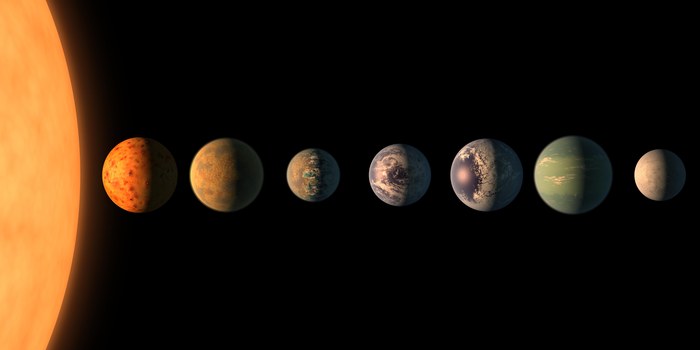
This artist's rendering lines up the seven planets of TRAPPIST-1 in order of increasing distance from their star, a red dwarf barely larger than Jupiter but far more massive. All seven are comparable in size to Earth or Venus, a remarkable fact in itself since exoplanets of this size remain statistically harder to detect than gas giants — the system was only detectable because its star, tiny and dim, lets its planets block a much larger fraction of its light during each transit.
Being so close to such a faint star, all seven planets orbit at distances far shorter than Mercury's orbit around the Sun, some completing their year in as little as 1.5 Earth days. Since most red dwarfs are prone to violent stellar flares, a central question of the ongoing James Webb observations is whether these planets have managed to hold onto an atmosphere in the face of such radiation bombardment — an answer that remains uncertain to this day, but crucial for assessing their real habitability.
Worlds of unsuspected diversity
The exoplanets discovered so far reveal a diversity that no model had anticipated before the first observations. Hot Jupiters, gas giants orbiting just days away from their star, have no equivalent in our own solar system. Super-Earths, more massive than Earth but smaller than Neptune, make up the most common size category in the galaxy — even though it is entirely absent around the Sun. Some exoplanets, such as those orbiting neutron stars, survive in radiation environments so extreme they seem to defy any possibility of life.
Kepler-452b, nicknamed Earth's "cousin," orbits within the habitable zone of a star very similar to the Sun, at a distance suggesting a potentially rocky size and composition — though without direct confirmation, since the planet is far too distant and small to be imaged or characterized in detail with current instruments.