Space Telescopes
Placed in orbit, these instruments escape the blur and absorption of Earth's atmosphere — at the cost of a launch that leaves almost no room for error, or for repair.
Hubble
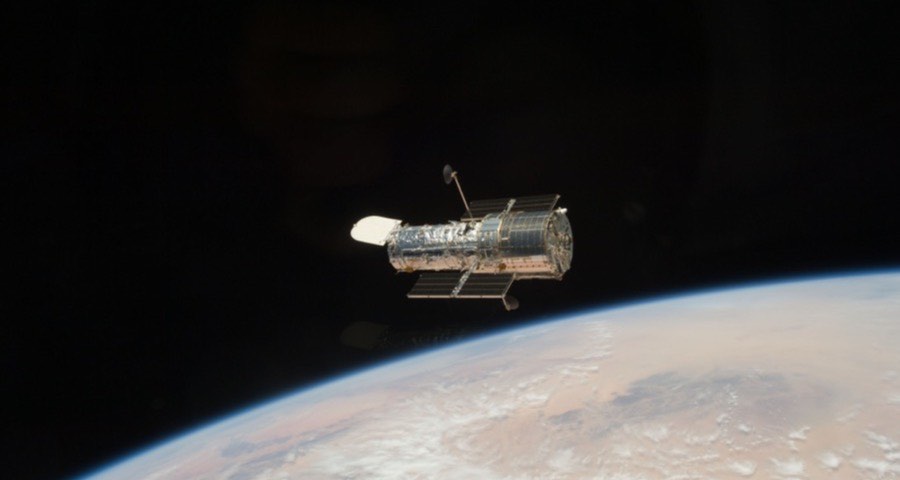
Launched in 1990, the Hubble Space Telescope initially suffered from a manufacturing flaw in its main mirror, corrected in 1993 during the first of a series of five servicing missions carried out by the space shuttle — the last direct human visit to a telescope in orbit. Since then, Hubble has produced some of the most famous images in astronomy, including the "Pillars of Creation" and the first deep field, revealing thousands of galaxies in a seemingly empty patch of sky.
More than three decades after its launch, Hubble remains fully operational, observing mainly in visible and ultraviolet light — a domain complementary to that of James Webb, which observes mostly in infrared.
James Webb
Hubble's successor, the James Webb Space Telescope (JWST) was launched in late 2021 after more than twenty years of development. Its segmented, gold-coated mirror, 6.5 meters in diameter — nearly three times wider than Hubble's — allows it to capture infrared light so faint that it sometimes comes from galaxies formed less than a billion years after the Big Bang.
Positioned at the L2 Lagrange point, 1.5 million km from Earth, James Webb is out of reach of any human servicing mission — every one of its fully automatic deployment mechanisms had to work perfectly on the first try. It can also be seen in Astrolab 3D's 3D experience, alongside the active probes.
See its current position in the 3D experience →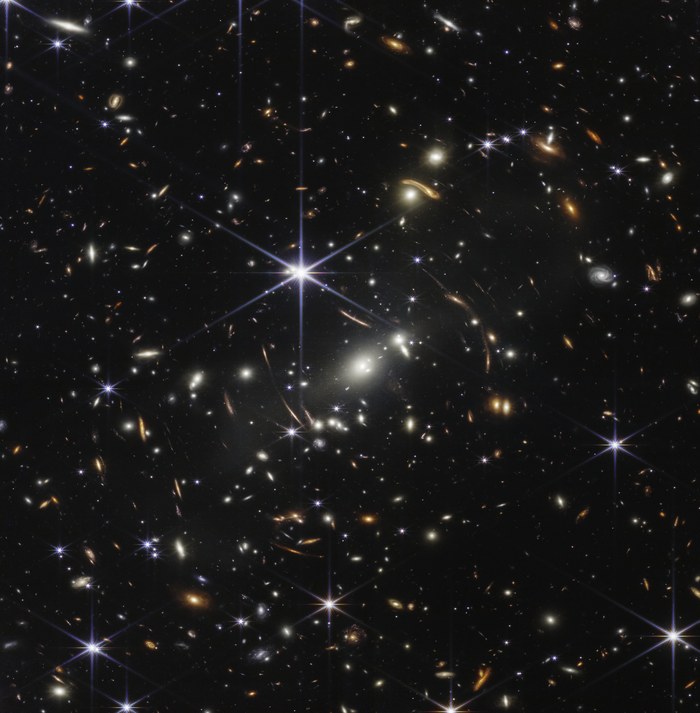
Unveiled on July 11, 2022 as the mission's very first public science image, this photograph of the galaxy cluster SMACS 0723 became James Webb's most famous image. Each point of light is an entire galaxy; the curved arcs and streaks visible around the center of the image are far more distant galaxies still, whose light has been stretched and magnified by the colossal gravity of the cluster sitting between them and us — a phenomenon called gravitational lensing, predicted by Einstein's general relativity.
Although this field covers only a patch of sky comparable to a grain of sand held at arm's length, it contains thousands of galaxies, some whose light took more than 13 billion years to reach us — among the oldest and most distant objects ever photographed, formed just a few hundred million years after the Big Bang.
Kepler
Launched in 2009, the Kepler Space Telescope revolutionized the search for exoplanets by continuously observing more than 150,000 stars, watching for tiny dips in brightness betraying a planet passing in front of its star — the so-called transit method. Kepler confirmed more than 2,600 exoplanets on its own, establishing that rocky planets comparable in size to Earth are extremely common in the galaxy.
After a partial failure of its reaction wheels in 2013, the mission was extended under the name K2, using an adapted observing method, until its fuel ran out in 2018.
Gaia
Launched in 2013 by ESA, the Gaia telescope is tasked with mapping, with unmatched precision, the position, distance, and motion of more than a billion stars in the Milky Way — a galactic census of unprecedented scale, published in successive waves of ever more precise data.
Gaia's data notably revealed that the Milky Way's disk is slightly warped, like a warped vinyl record, and made it possible to trace past mergers between our galaxy and other, now-disrupted dwarf galaxies — a subject covered in the Galactic Structure page.
TESS, Kepler's successor
Launched in 2018, the TESS (Transiting Exoplanet Survey Satellite) telescope uses the same transit method that made Kepler so successful, but with a very different observing strategy: rather than staring intensely at a small patch of sky for years, TESS sweeps almost the entire sky in successive wide sectors, prioritizing the brightest stars closest to the Sun. This approach greatly facilitates in-depth study of the exoplanets discovered by complementary telescopes such as James Webb, since nearby, bright stars deliver a much cleaner signal than the faint, distant targets favored by Kepler.
Still active, TESS has already confirmed several hundred exoplanets and identified several thousand additional candidates awaiting confirmation, tirelessly continuing its inventory of the worlds closest to our solar system.