The Big Bang and the Origin of the Universe
13.8 billion years ago, the entire universe — all of space, all of time, all matter — fit into a single point of unimaginable density. Then it began to expand, and it has never stopped since.
What the Big Bang isn't
Contrary to the popular image, the Big Bang was not an explosion that happened in space, at some precise spot that could in theory be located. It was space itself that began expanding from an extremely dense, hot state — so there is no "center" of the universe to head toward, and no point of origin to pinpoint in the sky: every point in space is moving away from every other point, somewhat like dots drawn on an inflating balloon all moving away from one another without any of them being the balloon's center.
Nor does the theory describe what "caused" the Big Bang, or what existed "before" it — questions that, given the current state of physics, may not even make sense, since time itself may have begun at that instant.
The observational evidence
Three major observations solidly support the Big Bang model. First, the expansion of the universe itself: in the 1920s, astronomer Edwin Hubble showed that distant galaxies recede from us faster the farther away they are — exactly what a space expanding from a compact initial state would predict.
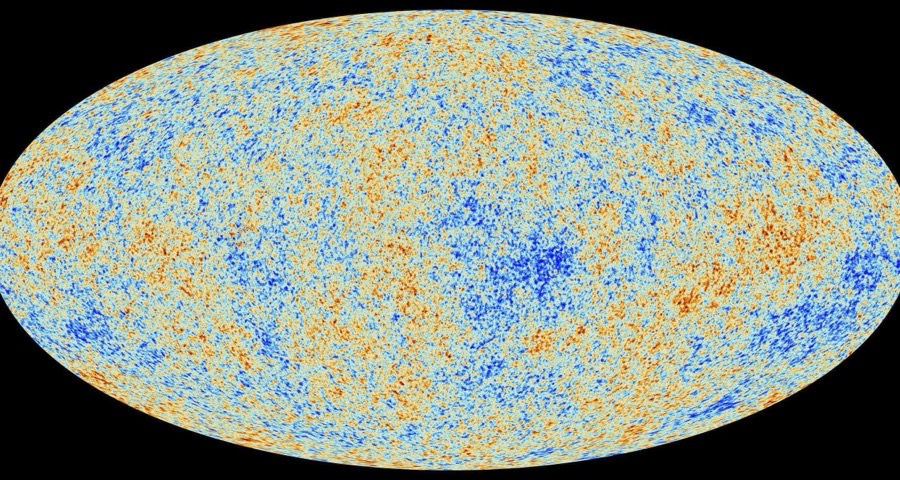
Second, the cosmic microwave background, discovered by accident in 1965: an extremely uniform microwave radiation that bathes the entire sky, the oldest light observable, emitted about 380,000 years after the Big Bang, at the moment the universe finally became transparent to light. Finally, the abundance of light elements (hydrogen, helium, and a little lithium) measured in the universe matches precisely what the calculations of primordial nucleosynthesis predict — the very first nuclear reactions that occurred in the minutes following the Big Bang.
Cosmic inflation
A fraction of a second after time zero — between roughly 10⁻³⁶ and 10⁻³² second — most cosmological models posit a phase of inflation: a dizzyingly fast expansion, during which the universe would have grown by a factor of at least 10²⁶ in an infinitesimal fraction of a second. This hypothesis, although not observed directly, helps explain several strange properties of the observable universe: its remarkable large-scale uniformity, and its overall flat geometry.
After inflation, the universe continued to expand much more slowly, gradually cooling to allow, in order, the formation of the first protons and neutrons, then the first light atomic nuclei, then — much later, 380,000 years after the Big Bang — the first neutral atoms, the event that made the universe transparent and produced the cosmic microwave background.
The dark ages and the first light
After the first atoms formed, the universe entered a long period called the dark ages: no star yet shone, and space remained plunged in near-total darkness, crossed only by the cooling glow of the cosmic microwave background. It took several hundred million additional years for gravity to gather enough primordial gas to ignite the very first stars and galaxies.
Observing this period remains one of the great challenges of modern astronomy: the James Webb space telescope, thanks to its unprecedented sensitivity in the infrared, has already spotted galaxies whose light took more than 13 billion years to reach us, revealing structures that were surprisingly already organized just a few hundred million years after the Big Bang.
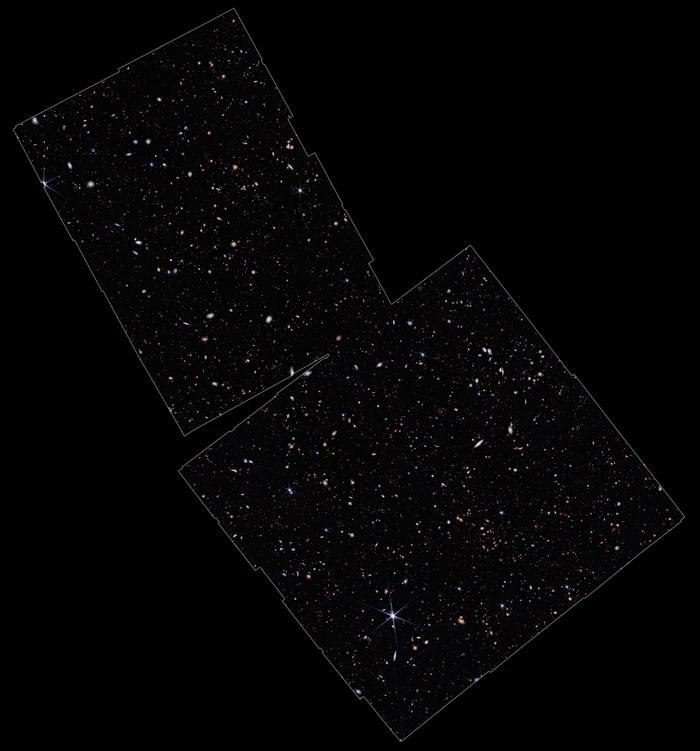
This image, one of the first from the JADES program (JWST Advanced Deep Extragalactic Survey), made it possible to identify hundreds of galaxies that already existed when the universe was less than 600 million years old — barely 4% of its current age. Some of these galaxies, even more distant and therefore older than those revealed by Webb's first deep field, have even upended theoretical models by turning out to be larger and richer in stars than expected for such an early era of cosmic history, just after the end of the dark ages.
Spotting these extremely distant galaxies relies on an indirect method: their light, considerably redshifted by the expansion of the universe over the course of its journey, only becomes detectable in the infrared — precisely the wavelength range where James Webb excels, and where Hubble, optimized mainly for visible light, reached its limits.
An accelerating expansion
In the late 1990s, two independent teams of astronomers, by measuring the brightness of distant supernovas, discovered to their surprise that the expansion of the universe is not slowing down under the pull of gravity as expected, but accelerating — a discovery that earned them the 2011 Nobel Prize in Physics. This phenomenon is attributed to dark energy, a still poorly understood component that appears to make up nearly 70% of the universe's total content.