Formation and Evolution
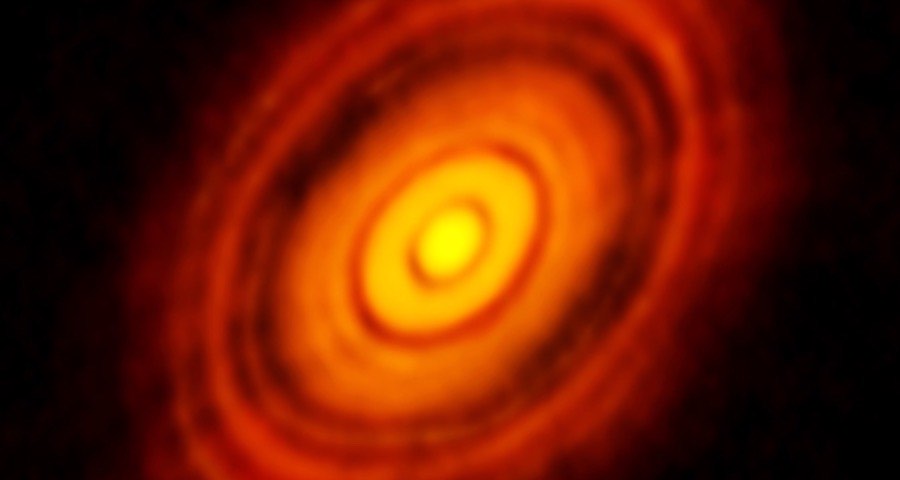
The solar system has not always had this orderly organization. It was born out of chaos, about 4.6 billion years ago — and the image above, taken around another star, shows literally what ours looked like at birth.
The solar nebula and the protoplanetary disk
It all began with the gravitational collapse of a vast cloud of gas and dust — a solar nebula — likely triggered by the shockwave of a nearby supernova. As it collapsed on itself, matter concentrated at the center to form the young Sun, while the rest flattened under rotation into a protoplanetary disk, a spinning disk of gas and dust surrounding the newborn star.
The opening image on this page, captured by the ALMA radio telescope array around the young star HL Tauri, shows exactly this stage: concentric rings carved into the disk, likely by planets in the process of forming that sweep up matter as they pass — a direct photograph of a process that can only be imagined for our own system, gone for billions of years.
Planetary accretion
Within this disk, microscopic grains of dust began clumping together through successive collisions, a process called accretion: first into larger grains, then pebbles, then rocks, then bodies several kilometers across called planetesimals. The largest planetesimals, thanks to their growing gravity, then attracted and absorbed their smaller neighbors, gradually growing into planets.
This process explains why the planets close to the Sun, where only rocky and metallic materials could remain solid, became small and dense, while those that formed beyond the frost line were able to accumulate enormous envelopes of gas and ice, becoming the giants Jupiter, Saturn, Uranus, and Neptune.
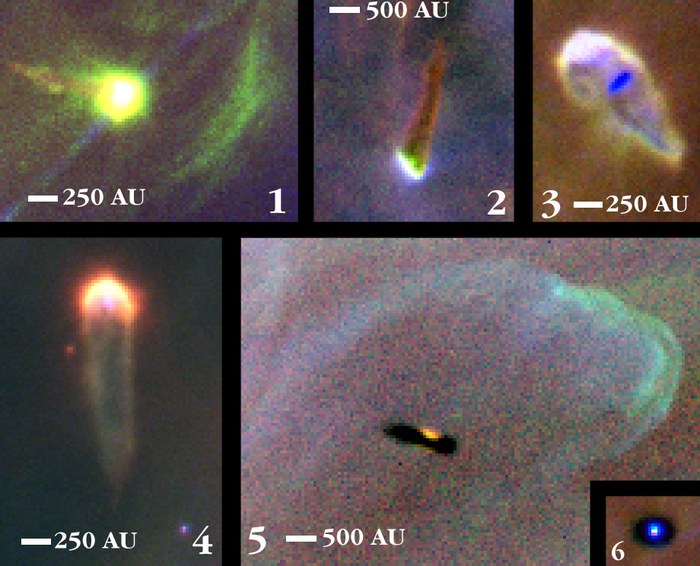
Discovered by Hubble in 1992 in the Orion Nebula, about 1,350 light-years from Earth, these five disks nicknamed "proplyds" (short for protoplanetary disks) show systems forming at different stages of their evolution, each one containing a young star surrounded by its disk of gas and dust — exactly the kind of environment where our own Sun and its planets formed 4.6 billion years ago. Unlike the calm disk of HL Tauri shown at the top of this page, these proplyds are bathed in the intense ultraviolet radiation of nearby massive stars, which gradually erodes and sculpts their disks into long, comet-like streamers.
The Orion Nebula, one of the closest and most studied star-forming nurseries in the Milky Way, hosts several hundred proplyds cataloged to date — offering astronomers a valuable statistical sample for understanding how quickly and under what conditions protoplanetary disks dissipate, a key piece of data for estimating how much time is available for planets to form before the disk's matter is swept away or absorbed.
The Late Heavy Bombardment
About 500 to 600 million years after the solar system formed, a period known as the Late Heavy Bombardment is thought to have seen a sharp increase in asteroid and comet impacts on the inner planets and moons, likely caused by a rearrangement of Jupiter and Saturn's orbits that would have destabilized part of the asteroid belt and more distant regions.
This period, whose true intensity is still debated among specialists, left its most visible mark on the Moon, whose cratered surface has changed almost not at all since — a fossil witness of this violent phase in the history of the solar system, which has since settled into the relatively stable equilibrium we still observe today.
Planets on the move
Modern models of solar system formation, such as the so-called Nice model or the "Grand Tack," suggest that the giant planets did not form exactly where they sit today. Jupiter, in particular, is thought to have migrated toward the inner solar system before heading back outward, driven by a temporary orbital resonance with Saturn — a back-and-forth movement that would have limited the mass available to form Mars, explaining why it remained much smaller than Earth or Venus.
These planetary migrations are also thought to have stirred up much of the asteroids and icy bodies, flinging some toward the inner system and ejecting others toward the outer reaches of the solar system — a plausible explanation for the origin of the Late Heavy Bombardment and for the asteroid belt's current structure, more scattered than uniform.
A system still evolving
The solar system is nothing like a fixed mechanism: planetary orbits undergo tiny chaotic variations over millions of years, studied through increasingly precise numerical simulations, without being able to predict its exact state beyond a few tens of millions of years with absolute certainty. Some models even point, over extremely long timescales, to a low but non-zero probability of orbital instability between Mercury and the other inner planets.
Over a much longer horizon still, the Sun's transformation into a red giant in about 5 billion years will permanently upend the system's current organization — and in about 4.5 billion years, the predicted collision between the Milky Way and the Andromeda galaxy will reshuffle the deck on a scale that goes far beyond the solar system itself.