Black Holes
Regions of space where gravity is so intense that nothing, not even light, can escape once it crosses the point of no return.
A gravity that traps light
A black hole forms when a sufficient amount of matter is compressed into a volume small enough that its gravity overwhelms any force capable of opposing it. Around it extends the event horizon, an invisible spherical boundary that marks no physical surface but marks the point of no return: within it, even light — which nonetheless travels at the maximum speed allowed by the universe — no longer has enough speed to escape.
What lies inside the horizon remains, by definition, inaccessible to direct observation. The equations of Einstein's general relativity predict a singularity at its center, a point where density would become infinite — but most physicists regard this prediction as a sign that the theory itself stops being valid at that scale, rather than a literal description of reality.
Stellar and supermassive black holes
Stellar black holes, the most common type, form when the core of a massive star collapses at the end of its life, after it has exhausted its nuclear fuel and blown off its outer layers in a supernova explosion. They typically weigh between a few and a few dozen solar masses.
At the other extreme, supermassive black holes, whose mass reaches millions or even billions of times that of the Sun, sit at the center of nearly all large galaxies — including our own. Their exact origin remains debated: gradual mergers of smaller black holes, direct collapse of enormous primordial gas clouds, or a combination of both depending on the case.
Sagittarius A*, the Milky Way's black hole
At the center of our own galaxy lies Sagittarius A*, a supermassive black hole of about 4 million solar masses. Its presence was inferred as early as the 1990s by tracking, over several decades, the orbits of stars whirling at very high speed around an invisible point — work that earned Reinhard Genzel and Andrea Ghez the 2020 Nobel Prize in Physics.
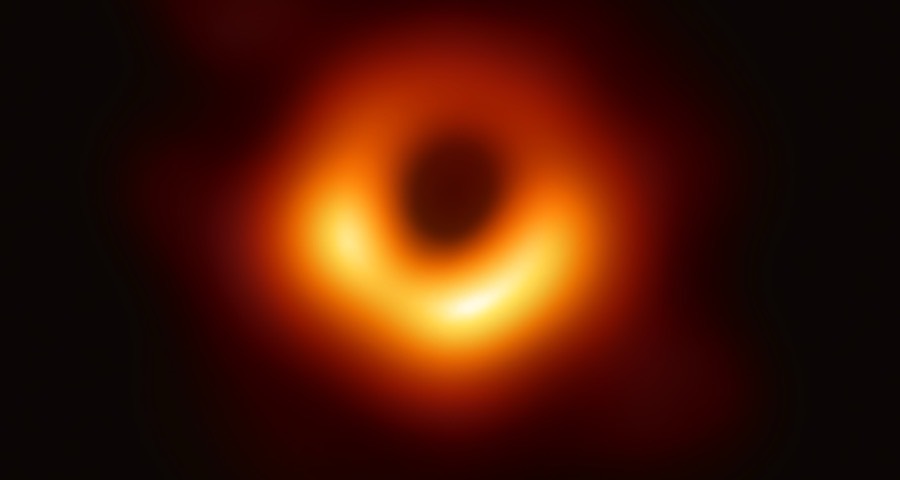
In May 2022, the Event Horizon Telescope collaboration published the very first direct image of Sagittarius A*, obtained by combining data from eight radio telescopes spread across the planet to form, in effect, a virtual telescope the size of Earth. The image shows a bright ring surrounding a dark central region — the silhouette of the event horizon projected onto the burning matter that surrounds it.
The first image of a black hole
Three years earlier, in April 2019, the same collaboration had already made headlines by publishing the first image ever obtained of a black hole: the far more massive one at the center of the galaxy M87, 55 million light-years from Earth, weighing about 6.5 billion solar masses. Unlike the relatively quiet Sagittarius A*, the one in M87 powers a powerful jet of matter that stretches across thousands of light-years, long visible to conventional optical telescopes.
What these images reveal is not the black hole itself — by definition invisible — but the photon ring, the light emitted by superheated matter orbiting just outside the horizon, bent by extreme gravity to the point of forming a characteristic halo all around the central shadow.
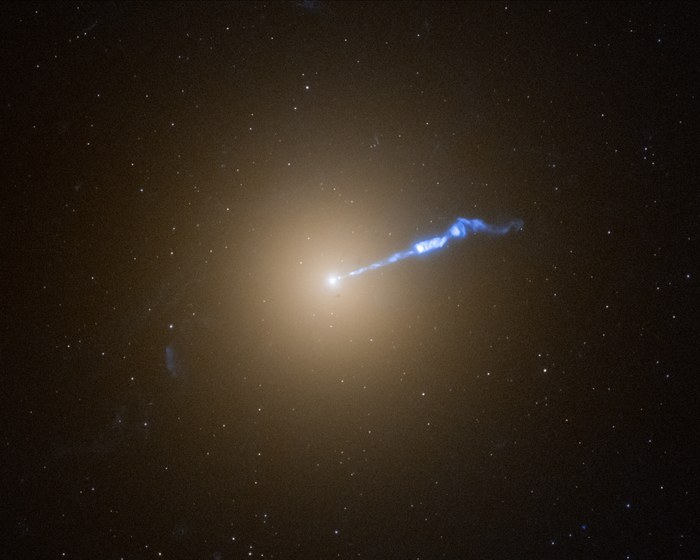
Long before the Event Horizon Telescope managed to photograph its shadow in 2019, M87's black hole had already given itself away on a much larger scale: this bluish plasma jet, seen here escaping from the galaxy's bright core, stretches about 3,000 light-years and travels at a speed close to that of light. It is produced by matter that, rather than falling directly into the black hole, is channeled and ejected along its rotation axis by intense magnetic fields — a mechanism still being studied in detail, yet capable of projecting matter over distances a thousand times greater than the size of the event horizon itself.
This jet has a measurable effect on its surroundings: astronomers have observed that stars located along its path have an unusually high probability of erupting as novae, without these stars being directly struck by the jet — an interaction still poorly understood between the jet's intense radiation and the surrounding matter, revealed precisely by this kind of high-resolution Hubble observation.
Gravitational waves: hearing collisions
Since 2015, the LIGO and Virgo detectors have directly picked up gravitational waves produced by the merger of two black holes — infinitesimal ripples in space-time itself, predicted by Einstein a century earlier but never directly observed until then. Each detected merger further confirms the existence of intermediate-mass black holes, difficult to spot with conventional optical methods, and opens up an entirely new way of observing the universe, complementary to light.