Dark Matter and Dark Energy
About 95% of the universe's total content escapes any direct observation — and yet its effects are everywhere, measurable with remarkable precision.
Missing mass
In the 1970s, astronomer Vera Rubin measured the rotation speed of stars in numerous spiral galaxies, expecting them to slow down with distance from the center, the way planets do around the Sun. Instead, the outer stars were rotating almost as fast as those near the center — a behavior impossible to explain using the galaxy's visible mass alone. An additional, invisible mass, spread through a vast halo surrounding each galaxy, was needed to supply the gravity required for this motion.
This invisible mass, named dark matter, emits, absorbs, and reflects no detectable light — hence its name, though "transparent matter" would probably be more accurate. It accounts for about 27% of the universe's total content, compared to only about 5% for ordinary matter (stars, planets, gas, dust — everything made of the atoms we know).
The Bullet Cluster, a visual proof
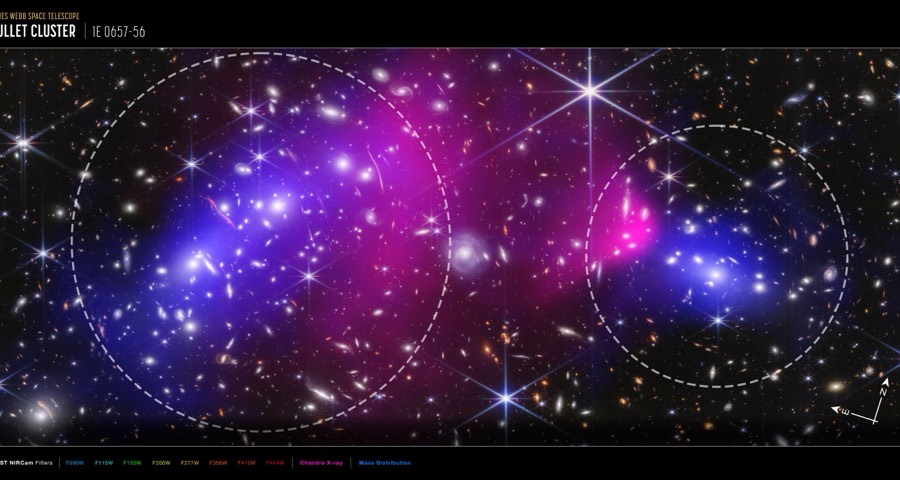
One of the most compelling pieces of evidence for the existence of dark matter comes from the Bullet Cluster, an ongoing collision between two clusters of galaxies. During such a collision, the hot gas of each cluster — which makes up most of their ordinary matter — collides and slows down, ending up at the center of the impact zone. Dark matter, which interacts almost only through gravity and barely at all with ordinary matter, passes straight through the collision without slowing, ending up ahead on each side.
By combining X-ray observations (which reveal the position of the hot gas) with measurements of gravitational lensing (which reveal where the mass actually concentrates, by observing how it distorts the light of background galaxies), astronomers were able to show that most of the Bullet Cluster's mass is offset from the visible gas — a signature that is hard to explain other than by the presence of dark matter.
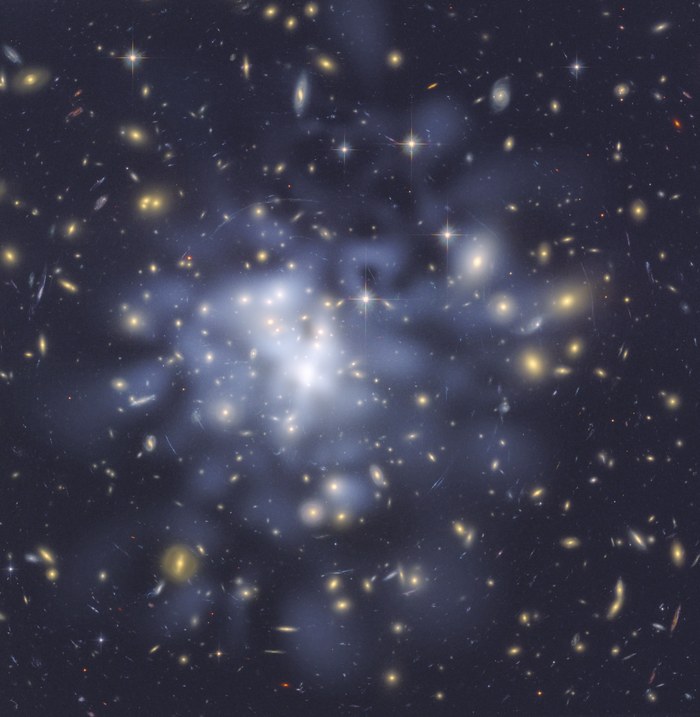
This image of the Abell 1689 cluster, which contains roughly a thousand galaxies, overlays a bluish map of dark matter onto the real Hubble photograph (the yellow and white points), mathematically reconstructed from how its mass distorts and bends the light of much more distant galaxies located behind the cluster — a gravitational lensing effect visible directly in the image as fine, curved arcs scattered across the field. This map reveals that dark matter is not spread evenly, but concentrates into a dense, irregular halo centered on the cluster, far more extensive than the visible matter alone.
This reconstruction technique, refined across dozens of galaxy clusters since the 2000s, allows astronomers to draw increasingly precise maps of how dark matter is distributed across the universe — never observing it directly, but systematically measuring its gravitational imprint on light arriving from far beyond it.
What could dark matter be?
Despite decades of research, the exact nature of dark matter remains one of the greatest unsolved mysteries in physics. The most studied hypothesis proposes WIMPs (weakly interacting massive particles), hypothetical particles that don't exist in any currently confirmed model of particle physics, but which several underground experiments are trying to detect directly, shielded from the noise of ordinary cosmic rays.
Other candidates include axions, even lighter and more hypothetical particles, or primordial black holes formed in the universe's very first moments. None of these hypotheses has been confirmed so far, and some physicists are even exploring modifications to the laws of gravity itself as an alternative — although this approach struggles to explain the full set of observations, particularly that of the Bullet Cluster.
Dark energy and the accelerating universe
Even more mysterious, dark energy accounts for nearly 68% of the universe's total content and is thought to be responsible for the acceleration of its expansion, discovered in 1998. Unlike dark matter, which attracts through gravity like any mass, dark energy appears to act as a form of negative pressure that pushes space itself apart, on the scale of the entire universe.
The simplest hypothesis equates it with the cosmological constant, a term Einstein himself had introduced — then rejected, later calling it the "biggest blunder" of his career — in his equations of general relativity, before it was discovered much later that a component of this type does indeed seem necessary to account for the observed accelerating expansion.
The standard model of cosmology
Taken together, these components — about 5% ordinary matter, 27% dark matter, and 68% dark energy — form what cosmologists call the Lambda-CDM model (for cold dark matter and cosmological constant), the reference theoretical framework that describes, with remarkable success, the structure and evolution of the observable universe, from the cosmic microwave background to the present-day arrangement of galaxies into giant clusters and filaments.