Large-Scale Phenomena
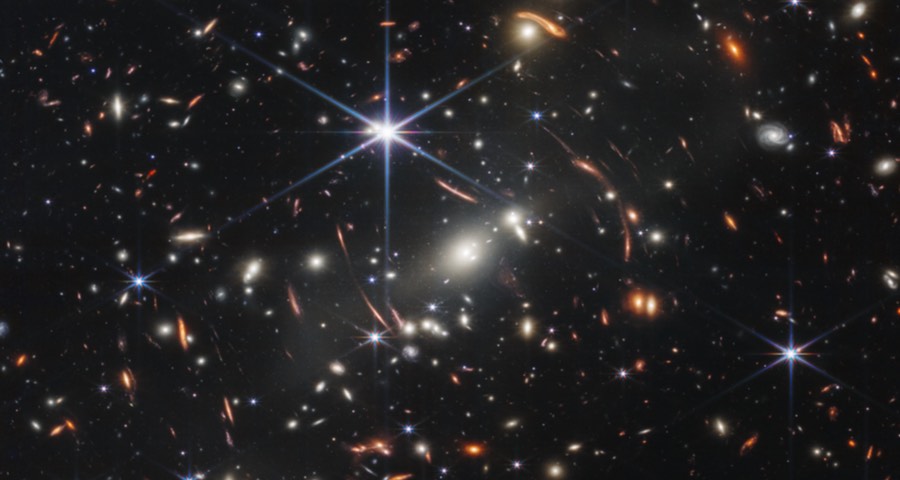
This image shows almost no stars from our own galaxy: nearly every point of light is an entire galaxy, some seen as they appeared more than 13 billion years ago.
Galaxy clusters and superclusters
Galaxies are almost never isolated: they group together into clusters that can hold several thousand members, bound by mutual gravity, which are themselves organized into even larger superclusters. The Milky Way belongs to the Local Group, some forty galaxies dominated by itself and the Andromeda galaxy, itself a member of the Virgo Supercluster — a structure spanning more than 100 million light-years.
At an even grander scale, superclusters organize into filaments and vast voids nearly devoid of matter, forming what astronomers call the cosmic web — the largest known organized structure in the universe.
Dark matter and dark energy
The visible mass of galaxies — stars, gas, dust — falls far short of explaining the speed at which they rotate or assemble into clusters: an additional, invisible mass, dark matter, appears to account for about 27% of the universe's total content, compared to just 5% for ordinary matter. Its existence is inferred only through its gravitational effects — notably gravitational lensing, visible in the image above as stretched arcs of light, where the mass of a galaxy cluster warps space-time and bends the light of far more distant galaxies located behind it.
The rest, about 68% of the universe, is thought to be dark energy — a repulsive force whose nature remains a complete mystery, but whose observed effect is to accelerate the expansion of the universe rather than slow it down, as gravity alone would suggest.
Redshift and the expansion of the universe
The more distant a galaxy is, the more its light reaches us stretched toward red wavelengths — an effect called redshift, analogous to the acoustic Doppler effect of a receding siren. It was precisely this observation, made by Edwin Hubble in the 1920s, that established that the universe is expanding: distant galaxies are moving apart from one another, and the farther away they are, the faster they recede.
This finding, combined with the laws of physics, makes it possible to trace time backward to an extremely dense and hot initial state: the Big Bang, about 13.8 billion years ago — a horizon that images like the Webb telescope's above allow us to approach a little more closely every year.
Gamma-ray bursts and gravitational waves
Gamma-ray bursts are among the most energetic events known in the universe: in a matter of seconds to minutes, they release as much energy as the Sun will produce over its entire lifetime. They are thought to be linked to the collapse of massive stars into black holes, or to the merger of two neutron stars — events so luminous they remain detectable from billions of light-years away, sometimes from the far edges of the observable universe.
These same mergers of compact objects (black holes, neutron stars) produce gravitational waves — ripples in space-time itself, predicted by Einstein in 1916 and directly detected for the first time only in 2015 by the LIGO detectors. This discovery opened up an entirely new way of observing the universe, complementary to light, by literally "listening" to the cosmos's most violent collisions.
The cosmic microwave background
About 380,000 years after the Big Bang, the universe had cooled enough for light to finally travel freely, without being constantly absorbed and re-emitted by the surrounding matter. This primordial light, stretched enormously by 13.8 billion years of expansion until it became microwave radiation barely 2.7 degrees above absolute zero, now bathes the entire universe: this is the cosmic microwave background, the oldest observable light, a kind of snapshot of the infant universe.
Its tiny temperature variations, mapped with increasing precision by the COBE, WMAP, and then Planck satellites, correspond to the seeds of future structures — clusters, superclusters, filaments — that would give rise, billions of years later, to the cosmic web observed today.
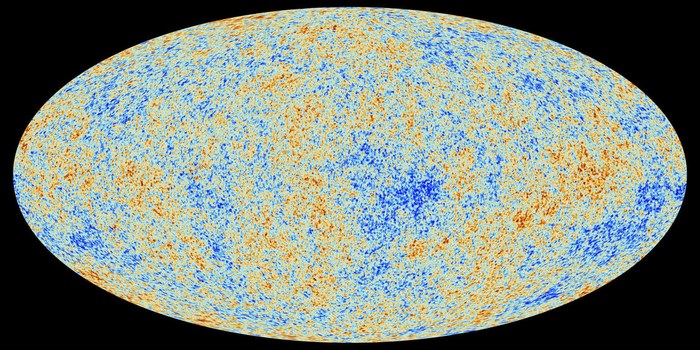
This map, produced by ESA's Planck satellite from more than four years of observations, projects the entire sky — the full 360° around us — onto a single ellipse, a mapping technique borrowed from terrestrial world maps. The colors, entirely artificial, encode incredibly tiny temperature deviations from the 2.7 kelvin average: red areas are only slightly warmer, blue areas only slightly cooler, with the total spread never exceeding one ten-thousandth of a degree.
Despite their tiny scale, these fluctuations are of enormous importance: they represent the density irregularities present in the primordial universe, just 380,000 years after the Big Bang, before gravity amplified these slight excesses of matter over billions of years to form galaxies, clusters, and ultimately all the large-scale structure observed today. Producing such a clean map requires considerable processing: the signal from the plane of the Milky Way, whose gas and dust also radiate at these wavelengths, must be carefully identified and numerically subtracted to leave only the underlying cosmological radiation.