Historic Missions
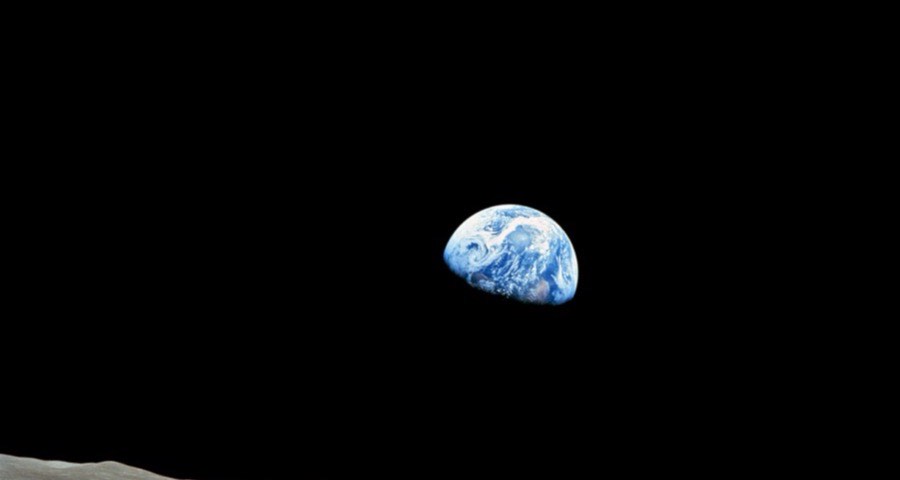
These missions have come to an end, but each one marked a definitive turning point in our knowledge of the solar system — the photo above, taken from lunar orbit in 1968, is itself a symbol of that.
The Apollo program
Between 1969 and 1972, six missions of the Apollo program landed twelve American astronauts on the Moon, the only time to date that humans have set foot on another celestial body. Apollo 11, in July 1969, remains the most iconic: Neil Armstrong and Buzz Aldrin became the first humans to walk on extraterrestrial ground, while Michael Collins waited for them in lunar orbit.
Beyond the feat itself, the Apollo missions returned 382 kg of lunar rock, still studied today, and helped confirm the giant-impact hypothesis for the Moon's formation. The "Earthrise" photo, taken by the Apollo 8 crew during the preceding mission, is often credited with helping spark the environmental movement by showing, for the first time, the fragility of the whole Earth from space.
Pioneer 10 and 11
Launched in 1972 and 1973, the Pioneer 10 and 11 probes were the first to cross the asteroid belt and fly by Jupiter, paving the way for the Voyager missions that would follow a few years later. Pioneer 11 then continued on to Saturn, which it flew by in 1979, the very first visit to the ringed planet.
Both probes carry an engraved plaque depicting a human silhouette and the Sun's position within the galaxy — a precursor to Voyager's Golden Record. Contact with Pioneer 10 was lost in 2003; it continues silently on its way toward interstellar space.
Viking 1 and 2
In 1976, the Viking 1 and 2 missions achieved the first successful American landings on Mars, each made up of an orbiter and a lander. The landers carried out the very first biological experiments conducted directly on the surface of another planet, searching for signs of microbial activity — results that remain ambiguous and still debated today, but that laid the methodological groundwork for all of modern Martian astrobiology.
Viking 1 remained operational on the surface of Mars for more than six years, a longevity record for its time.
Galileo
In orbit around Jupiter from 1995 to 2003, Galileo released a small atmospheric probe that directly measured the composition of Jupiter's clouds during its descent, and discovered the most compelling evidence yet of a liquid water ocean beneath Europa's icy crust — a discovery that has kept this moon among the top priority targets in the search for extraterrestrial life ever since.
To avoid any accidental biological contamination of Europa at the end of the mission, the probe was deliberately destroyed in Jupiter's atmosphere in 2003 — an end-of-life procedure that would later become the standard, followed again by Cassini in 2017.
Cassini-Huygens
A joint NASA/ESA mission, Cassini orbited Saturn from 2004 to 2017, delivering most of what we know today about its rings, moons, and weather. It released the European Huygens module, which landed on Titan in January 2005 — the first successful landing in the outer solar system, on a moon whose atmosphere and lakes of liquid hydrocarbons had, until then, only been glimpsed from orbit.
Cassini ended its mission with a deliberate plunge into Saturn's atmosphere, to protect Enceladus and Titan — two moons considered potentially habitable — from any contamination from Earth.
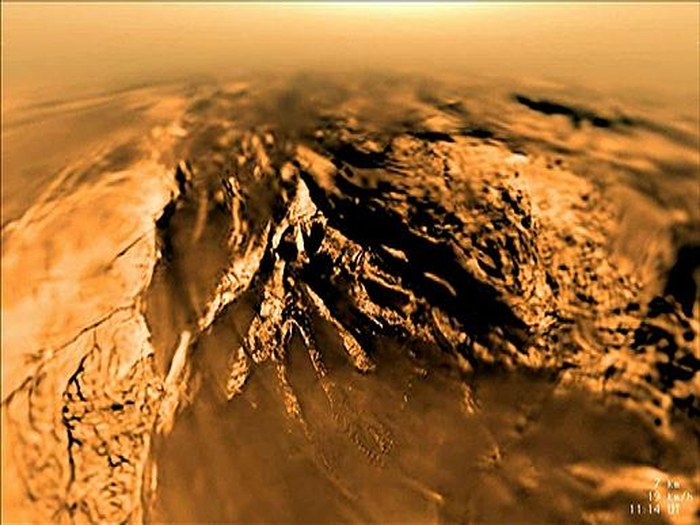
Taken during Huygens' parachute descent, at an altitude of about 8 km, this fisheye image reveals a landscape strikingly familiar in appearance: branching drainage channels winding between dark ridges, a topography immediately reminiscent of rivers on Earth — except that here, at -180°C, it wasn't water that carved this terrain, but liquid methane, one of the few compounds that can exist in liquid form at such an extreme temperature.
Huygens survived only about 90 minutes on the surface before its batteries ran out, but this handful of photographs, transmitted from a world more than 1.2 billion kilometers from Earth, remains to this day the only view ever obtained from the ground of a body in the outer solar system — Titan remains the most distant moon on which a human-built craft has ever landed.
Rosetta
Launched in 2004, the European probe Rosetta achieved a historic first in 2014 by entering orbit around a comet, 67P/Churyumov-Gerasimenko, which it accompanied for more than two years as it approached and then moved away from the Sun. It released the small Philae lander onto its surface — an eventful landing, with Philae bouncing before coming to rest in a shadowed area that limited its solar power generation.
Rosetta confirmed that comets rank among the most primitive objects in the solar system, virtually unchanged since its formation, and ended its mission with a controlled landing on the cometary nucleus itself in 2016.