Types of Galaxies
Hundreds of billions of galaxies populate the observable universe — and yet nearly all of them fall into just three major families.
Spiral galaxies
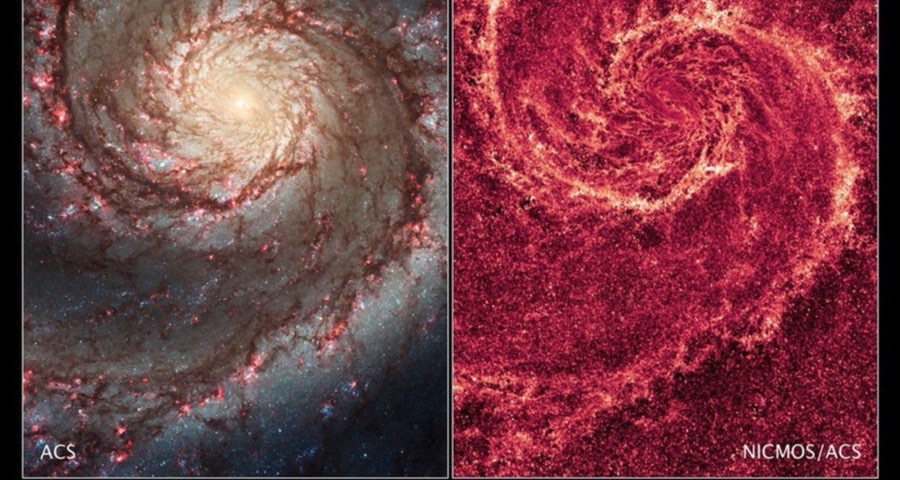
Spiral galaxies, such as our own Milky Way or the Whirlpool Galaxy (M51) photographed above, are characterized by a flattened disk crossed by luminous spiral arms, where the most active star-forming regions are concentrated. At the center sits a dense, bright nucleus, often crossed through the middle by a bar of stars in about two-thirds of spirals, including our own.
Spiral arms are not fixed structures: they are density waves moving through the disk, comparable to a traffic jam on a highway — individual stars enter and leave the arms as they orbit, but the spiral pattern itself persists.
Elliptical galaxies
Elliptical galaxies have a much simpler shape, ranging from spherical to highly elongated, with no arms or distinct disk. They generally contain older stars and little cold gas, which explains their low rate of new star formation compared to spirals — they are often described as "dead" in terms of star formation.
The largest known structures of this type, giant ellipticals, are typically found at the center of dense galaxy clusters, where they likely formed through the repeated merging of several smaller galaxies over billions of years.
Irregular galaxies
Irregular galaxies have neither the symmetry of spirals nor the smooth shape of ellipticals — often the result of a recent collision or gravitational interaction with a neighboring galaxy, which distorted their original structure. The Large Magellanic Cloud and the Small Magellanic Cloud, two satellite galaxies visible to the naked eye from the southern hemisphere, are nearby examples, likely disturbed by their repeated close passes near the Milky Way.
Dwarf galaxies
Far less spectacular than the large spirals, dwarf galaxies — sometimes containing only a few thousand or million stars, compared to the hundreds of billions in the Milky Way — are in fact the most common type of galaxy in the universe. The Milky Way is surrounded by dozens of dwarf satellite galaxies, such as the Large Magellanic Cloud or the Sagittarius Dwarf galaxy, currently being slowly torn apart and absorbed by our own galaxy.
These dwarf galaxies play a key role in models of large-galaxy formation: according to the so-called hierarchical formation scenario, today's large spirals and ellipticals would have built up through successive mergers of smaller structures — a process that continues today, albeit on a smaller scale.
Galaxies caught in collision
On a cosmic scale, collisions between galaxies are common and rarely destructive to the stars themselves: the distances between individual stars are so vast that two galaxies can pass through each other with almost no star directly colliding with another. On the other hand, gravitational tidal forces profoundly reshape their respective structures, capable of turning two well-ordered spirals into an irregular galaxy, or triggering a burst of star formation by abruptly compressing their gas reserves.
Over billions of years, repeated collisions can also transform spirals into elliptical galaxies — one of the mechanisms proposed to explain the presence of giant ellipticals at the center of dense galaxy clusters, where collisions are most frequent.
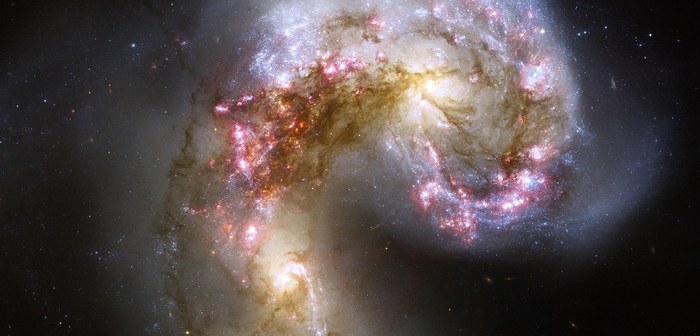
The Antennae Galaxies, located about 60 million light-years away, offer one of the most spectacular and well-documented examples of a galactic collision. Two spiral galaxies, locked in this merger for several hundred million years already, have had their arms stretched into long trails of stars torn away by tidal forces — visible outside the frame in wider images, hence the name "Antennae." At the center of the image, the violent compression of interstellar gas clouds has triggered a burst of star formation of an intensity rarely observed, with each bright pink dot marking a cluster of thousands of young stars born within just a few million years.
The complete merger of the two galaxies should be finished within several hundred million years, likely giving birth to a single elliptical galaxy — a real-time preview of the fate awaiting our own Milky Way, currently on a collision course with the Andromeda galaxy, in a scenario expected in about 4.5 billion years.