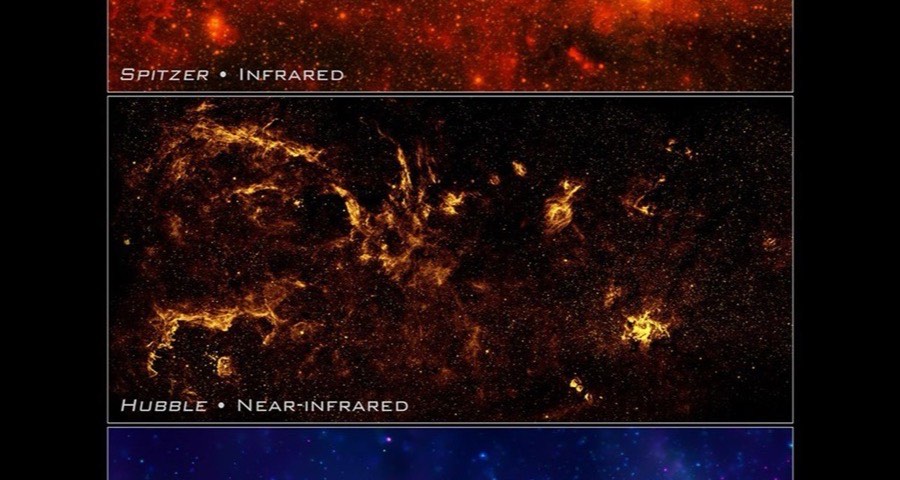
Galactic Structure
The Sun and its system are just one point among hundreds of billions of others, about 27,000 light-years from the center of the Milky Way — far enough that we can never directly see its heart with the naked eye.
Disk and spiral arms
The Milky Way is a barred spiral galaxy about 100,000 light-years in diameter, most of whose stars — including the Sun — sit within a galactic disk flattened to just a few thousand light-years thick. Our solar system resides in one of the secondary spiral arms, the Orion Arm, roughly halfway between the center and the edge of the disk.
The Sun takes about 230 million years to complete one full orbit around the galactic center — so long that it has only completed about twenty orbits since its formation, even though Earth has already made more than 4.5 billion rotations around it.
Bulge and halo
At the center of the galaxy lies the galactic bulge, a dense, roughly spherical concentration of old stars, on average much older than those in the disk. All around it, a much larger and more diffuse halo extends far beyond the visible disk, populated by globular clusters of ancient stars and, according to most current models, a considerable amount of invisible dark matter whose mass would greatly exceed that of all visible matter combined.
The central supermassive black hole
At the exact heart of the Milky Way lies Sagittarius A*, a supermassive black hole of about 4 million times the mass of the Sun. Its existence was unambiguously confirmed by tracking, over decades, the orbits of individual stars whirling at very high speed around an invisible point — work that earned Reinhard Genzel and Andrea Ghez the 2020 Nobel Prize in Physics. In 2022, the Event Horizon Telescope even produced the very first direct image of it, showing a ring of light surrounding its shadow.
Nearly all large galaxies, including elliptical ones, appear to host a comparable supermassive black hole at their center — a feature that may be linked to their very formation.
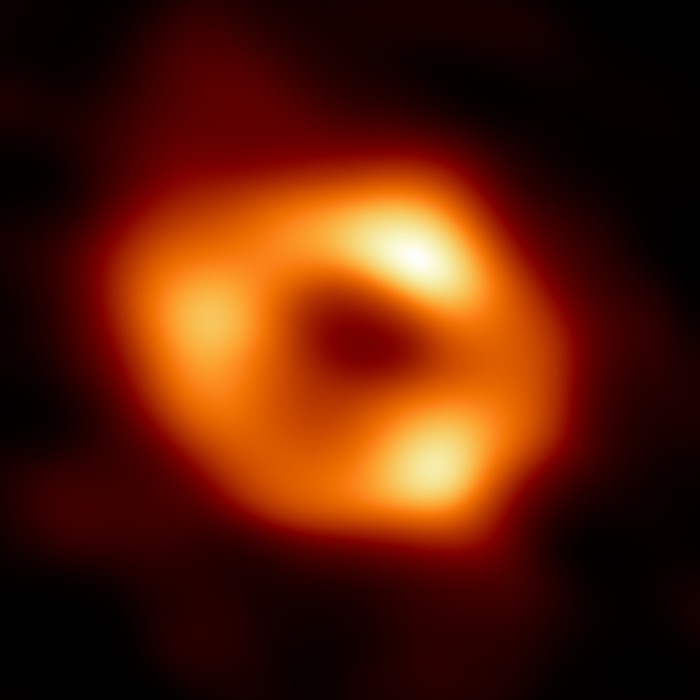
Unveiled in May 2022, this image shows a bright, asymmetric ring of superheated gas surrounding a dark central region — the shadow of the black hole, the zone from which no light can escape. It was not captured by a single instrument, but reconstructed from combined data collected by eight radio telescopes spread across the planet, from Antarctica to Chile, working simultaneously as a single virtual telescope the size of Earth — the only way to achieve the resolution needed to make out an object this compact at a distance of 27,000 light-years.
Photographing Sagittarius A* proved far more difficult than imaging M87*, the first black hole ever imaged by the same collaboration in 2019: although Sagittarius A* is much closer, matter orbits it so quickly — in just minutes, compared to several days for M87* — that its appearance changes noticeably even within the span of a single observation, forcing the teams to develop new techniques to reconstruct a sharp image despite this constant motion.
A galaxy that's hard to map from the inside
Paradoxically, it's easier to produce a detailed map of a neighboring galaxy than of our own: observing the Milky Way from within the Sun's position is like trying to draw the layout of a forest while stuck between the trees, with the added difficulty of thick clouds of interstellar dust that block visible light toward the galactic center. Astronomers work around this obstacle by observing at other wavelengths — infrared, radio, X-ray — which pass through dust more easily.
The European space mission Gaia, launched in 2013, has considerably refined this map by measuring, with unprecedented precision, the position, distance, and motion of more than a billion stars, notably revealing that the galactic disk is slightly warped, like a warped vinyl record, probably under the gravitational influence of interacting dwarf galaxies.
A collision to come
The Milky Way and the Andromeda galaxy, its largest neighbor, are approaching each other at about 110 km/s and are expected to collide in about 4.5 billion years — a timeline strikingly close to that of the Sun's transformation into a red giant. As with any galactic collision, individual stars will almost never collide directly with one another, but the two galaxies will gradually merge over several hundred million years to form a single elliptical galaxy, sometimes nicknamed in advance "Milkomeda."
The solar system, for its part, will most likely survive this merger, simply shifted to a different region of the resulting galaxy — a timescale so distant that the Sun will, in any case, have already well begun its own transformation into a giant star by then.