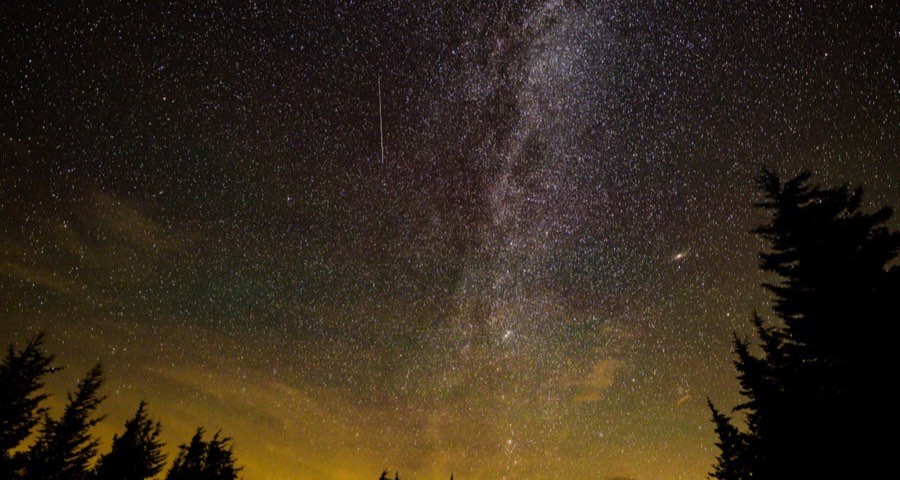
Meteor Showers
Every year, on the same dates, Earth faithfully passes through the trails of dust left behind by the comets that came before it.
A comet's wake
With each pass near the Sun, a comet sheds some of its ice and dust, which slowly scatter along the length of its orbit. When Earth, on its yearly circuit around the Sun, crosses one of these debris trails, thousands of dust grains — often no bigger than a grain of sand — burn up in the atmosphere over the course of a few nights: this is a meteor shower.
Because Earth passes through the same point in its orbit each year at the same time, these showers are perfectly predictable and return on the same dates, year after year, sometimes to within a single day.
The radiant: a vanishing point in the sky
All the meteors in a given shower appear to burst from a single point in the sky, called the radiant — a pure effect of perspective, since the particles are actually traveling along parallel paths. It's this radiant, and the constellation in which it sits, that gives the shower its name: the Perseids appear to radiate from the constellation Perseus, the Leonids from Leo.
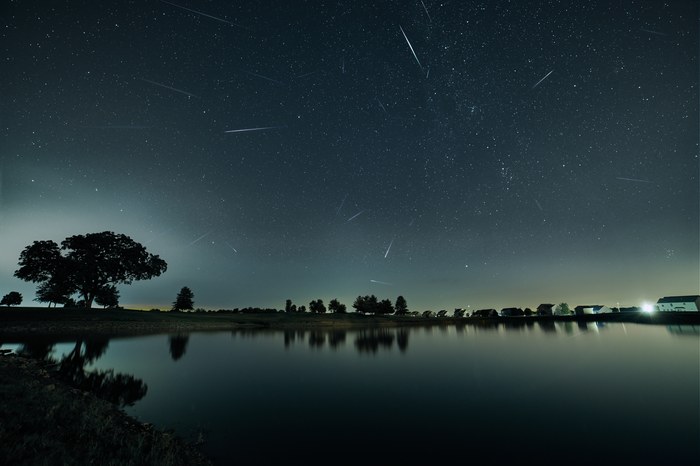
This composite image, assembled from dozens of photographs taken over a single night of Perseid observation, lets you see at a glance what the eye never perceives all at once: the luminous trails, though captured at different moments, nearly all align along directions that, if extended, would converge on the shower's radiant somewhere outside the frame. Any photographer building this kind of image has to shoot continuously for hours, with a camera fixed on a tripod, before digitally stacking only the frames in which a meteor was captured.
In practice, the farther a meteor appears from the radiant in the sky, the longer its trail looks — another perspective effect directly tied to the angle at which we observe its actual trajectory, which is parallel to all the others.
The calendar of major showers
The Perseids, active in mid-August, are among the most watched in the northern hemisphere: inherited from Comet Swift-Tuttle, they benefit from mild, clear summer nights. The Geminids, in mid-December, are often the densest shower of the year, sometimes producing over a hundred meteors per hour under good conditions — a special case, since they come not from a comet but from the asteroid Phaethon. The Leonids, in November, are best known for their rare but spectacular "meteor storms," such as those observed in 1833 and 1966, when thousands of meteors per hour were reported.
Other showers punctuate the year: the Quadrantids in January, the Lyrids in April, the Eta Aquariids in May (also originating from the debris of Halley's Comet), and the Orionids in October, which come from that same comet but are crossed at a different point in its orbit.
Observing a meteor shower well
No equipment is needed — in fact, binoculars and telescopes reduce the useful field of view. The most effective approach is to get away from any light pollution, give your eyes about twenty minutes to adjust to the dark, and look broadly across the sky rather than staring at the radiant itself, where the trails are shortest.
The zenithal hourly rate: a figure to take with a grain of salt
The intensity of a meteor shower is expressed as its zenithal hourly rate (ZHR): the number of meteors an observer would see in one hour if the radiant sat exactly at the zenith, under a perfectly dark sky with no light pollution at all. It's a theoretical reference value, almost always optimistic: in practice, the Moon, clouds, urban light pollution, and the radiant's actual height in the sky sharply reduce the number of meteors actually visible, often to just a fraction of the announced ZHR.
That's why the best night to observe a given shower depends not only on the parent comet's peak activity, but also on the Moon's phase that year: a strong shower coinciding with a full moon can disappoint far more than a milder shower observed under a moonless sky.