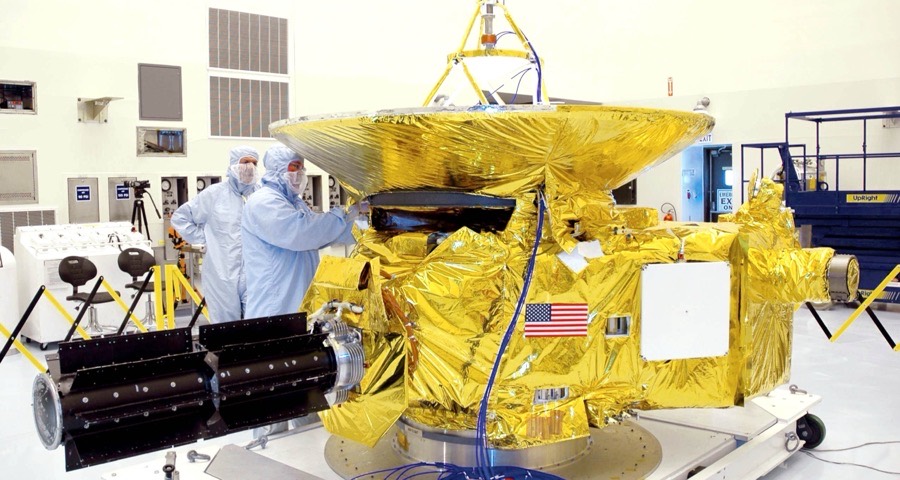
New Horizons
Launched in 2006 for a rendezvous with the only planet in the solar system not yet visited at the time — Pluto — New Horizons took nearly ten years to cover the 5 billion kilometers separating it from its target.
See its current position in the 3D experience →A nine-and-a-half-year journey
New Horizons lifted off on January 19, 2006, from Cape Canaveral, propelled by an Atlas V rocket configured to give it the highest launch speed ever reached by a human-made object — it left Earth orbit at over 58,000 km/h. It flew past Jupiter as early as February 2007, using its gravitational field to gain even more speed and shave several years off its travel time, while observing the planet's atmosphere and moons along the way.
For most of its cruise toward Pluto, the spacecraft spent the bulk of its time in electronic hibernation to preserve its instruments and limit tracking costs, waking up periodically for routine checks.
The historic Pluto flyby
On July 14, 2015, New Horizons flew past Pluto at a distance of just 12,500 km, at a relative speed of nearly 14 km/s — a lightning-fast pass lasting only a few hours, since Pluto is far too distant to allow for orbital insertion. The images returned revealed a world far more geologically active than expected: a vast, heart-shaped plain of nitrogen ice named Tombaugh Regio, mountain ranges of water ice rising over 3,500 meters, and a thin but layered atmosphere made up of dozens of haze layers.
The spacecraft also photographed Charon, Pluto's largest moon, revealing a gigantic canyon system and a dark polar region nicknamed Mordor Macula. To this day, this flyby remains the only close exploration ever conducted of Pluto and its moon system.
The heart of Pluto
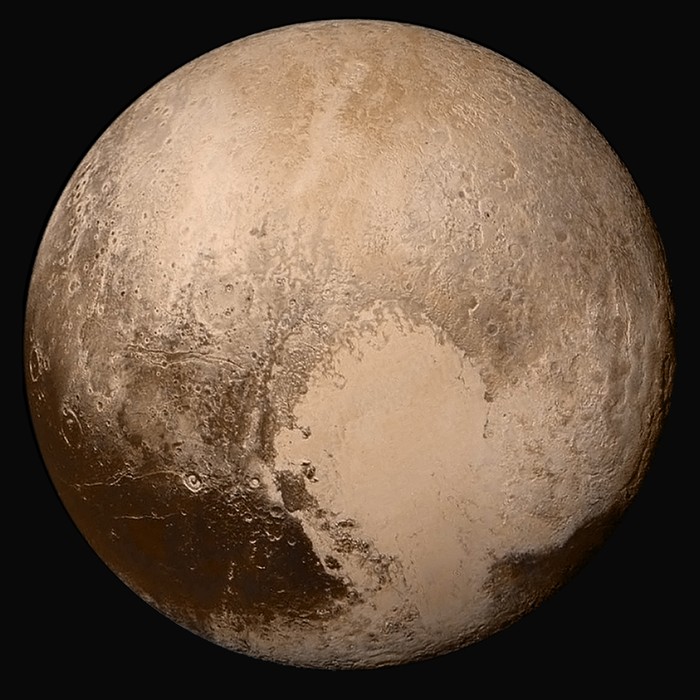
This true-color image, composed from data gathered by New Horizons during its July 2015 approach, has become the reference image of Pluto: it reveals in a single frame the dwarf planet's unexpected geological diversity, from the dark, cracked terrain of Cthulhu Macula on the left to the vast bright expanse of Tombaugh Regio, the heart-shaped plain that immediately captivated the public when it was released. The heart's western lobe, Sputnik Planitia, turned out to be a nitrogen ice plain in a state of perpetual renewal, organized into convection cells tens of kilometers wide — a completely unexpected geological activity for a world this small and this cold, lacking the tidal heating that animates moons like Europa or Enceladus.
Tombaugh Regio is named after Clyde Tombaugh, the astronomer who discovered Pluto in 1930 — a tribute made all the more meaningful by the fact that his ashes are traveling aboard the very spacecraft that made it possible, 85 years later, to photograph this region for the first time.
Arrokoth, at the edge of the Kuiper Belt
After Pluto, New Horizons continued on toward the Kuiper Belt, that icy region beyond Neptune home to millions of primitive objects dating back to the solar system's formation. On January 1, 2019, it flew past Arrokoth (initially designated 2014 MU69), a small object barely 36 km long with an unusual shape of two lobes fused together, like a flattened snowman.
Located more than 6.4 billion km from the Sun, Arrokoth is the most distant and most primitive object ever visited up close by a space probe. Its structure suggests it formed through the gentle merging of two separate bodies at very low speed, offering a near-pristine glimpse of the very earliest stages of planetary formation, 4.6 billion years ago.
And after that?
New Horizons continues to observe the Kuiper Belt and the distant interplanetary medium from afar, and could receive a new flyby target if a suitable object is identified along its future path. The spacecraft still has enough power and fuel to continue its science operations at least until the mid-2030s, at which point its radioisotope generator will no longer provide enough power to run its instruments.
A tribute onboard, a planet demoted along the way
New Horizons carries a small amount of the ashes of Clyde Tombaugh, the American astronomer who discovered Pluto in 1930, along with a compact disc containing the names of more than 434,000 people who took part in a collection campaign organized before launch. The spacecraft also carries a 1991 US postage stamp reading "Pluto: Not Yet Explored," photographed onboard at the moment of the flyby to symbolically mark the fulfillment of that promise.
A quirk of timing: barely seven months after New Horizons launched, the International Astronomical Union redefined the concept of a planet in 2006, reclassifying Pluto as a dwarf planet. The spacecraft thus found itself exploring a world whose official status had changed while it was already en route — a controversy still very much alive among the public and part of the scientific community, one that New Horizons' discoveries about Pluto's geological complexity have only fueled further.