Voyager 1
Launched in 1977 for a simple flyby of Jupiter and Saturn, Voyager 1 became the first object built by humanity to leave the Sun's domain of influence. It is still flying today, more than 22 light-hours from Earth.
See its current position in the 3D experience →A launch for a shortened "Grand Tour"
Voyager 1 lifted off on September 5, 1977, from Cape Canaveral, sixteen days after its twin spacecraft Voyager 2, but on a faster trajectory that let it catch up to and then overtake it. It took advantage of a favorable planetary alignment, exploited by NASA for a chain of flybys: each giant planet offered the spacecraft a gravity assist that accelerated it and redirected it toward the next one, without using any additional fuel.
Voyager 1 flew past Jupiter in March 1979, revealing active volcanoes on the moon Io — the first volcanic activity ever observed anywhere other than Earth — then flew past Saturn in November 1980. It was during this second flyby that the spacecraft's trajectory was deliberately bent north out of the solar system's plane, to allow a close pass by Titan, Saturn's largest moon. This scientific choice ended any hope of visiting Uranus and Neptune: Voyager 1 permanently left the ecliptic plane.
Leaving the solar system
After Saturn, Voyager 1 continued outward through the solar system for more than three decades. On August 25, 2012, it crossed the heliopause — the boundary where the solar wind, that continuous stream of charged particles emitted by the Sun, gives way to the interstellar medium bathing the rest of the galaxy. Voyager 1 thus became the first object built by humanity to leave the heliosphere and officially enter interstellar space.
Scientists confirmed the crossing through a sharp increase in the density of the surrounding plasma, measured by the spacecraft's instruments — a characteristic signature of the interstellar medium, far denser than the rarefied solar wind. Since then, Voyager 1 has continued moving outward at about 3.6 astronomical units (AU) per year, or more than 17 km per second.
The Golden Record
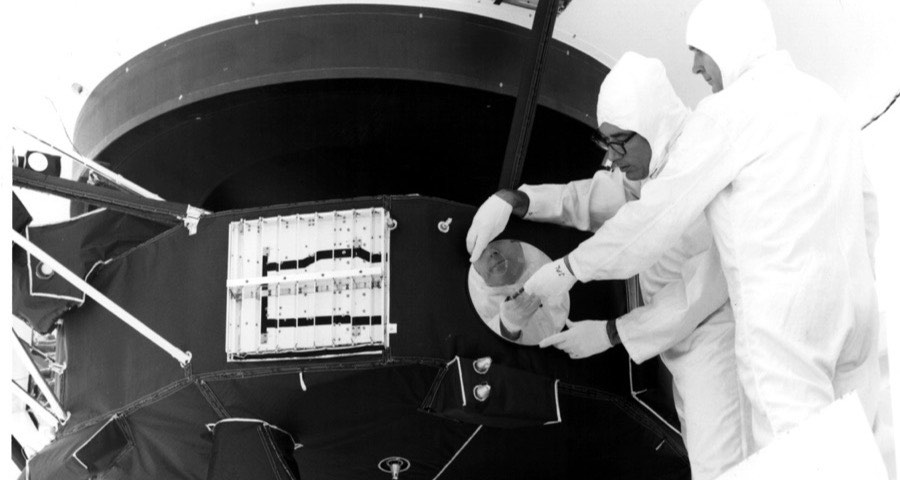
Voyager 1 carries an object unique in the history of space exploration: the Golden Record, a gold-plated copper phonograph record 30 centimeters in diameter, produced under the direction of astronomer Carl Sagan. It contains 115 encoded images, sounds of Earth (waves, wind, animals, laughter), greetings in 55 human languages, and a selection of music ranging from Bach to traditional songs from many cultures.
The record comes with a cover etched with symbolic instructions for playing it, and a diagram showing the Sun's position relative to fourteen pulsars — a kind of map allowing any future discoverers, in an extremely distant future, to locate its point of origin. It is not a message meant to be received within our lifetimes: the Golden Record is, above all, a testament left for the stars.
The "Pale Blue Dot"
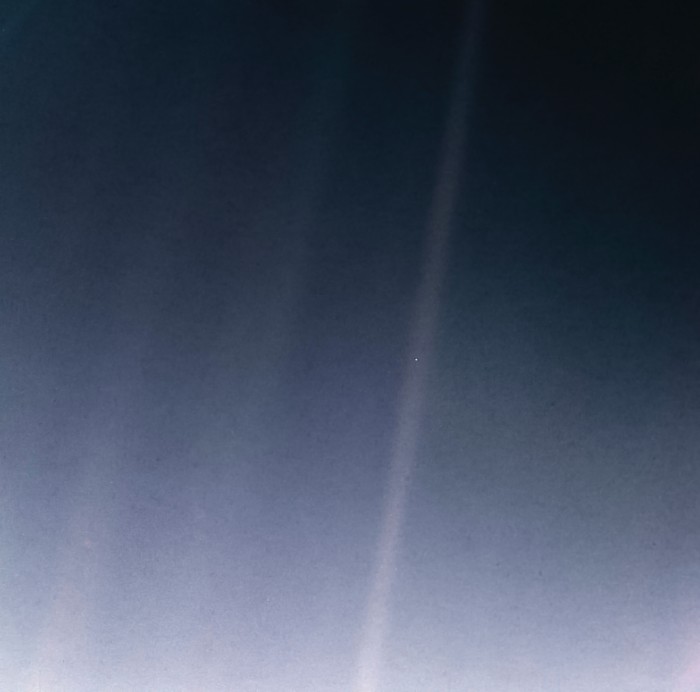
On February 14, 1990, as Voyager 1 was completing its primary planetary mission and preparing to leave the plane of the solar system for good, the mission team made the exceptional decision to turn its cameras back inward and photograph Earth from more than 6 billion kilometers away — an idea pushed insistently by astronomer Carl Sagan, a member of the science team. In the image, our entire planet occupies just a single pixel, a tiny dot suspended within a band of sunlight scattered inside the camera's own lens.
Sagan popularized this image under the name "Pale Blue Dot" and drew from it a now-famous reflection on Earth's fragility and isolation within the cosmic vastness. It was the last photograph ever taken by Voyager 1: its cameras were switched off shortly afterward to conserve remaining power, making the image all the more symbolic — the spacecraft's final glance back at its home world before plunging permanently into interstellar space.
A mission that defies time
Voyager 1 runs on three radioisotope thermoelectric generators (RTGs), which convert the heat from the natural decay of plutonium-238 into electricity. This power source declines slowly, by about 4 watts per year, forcing the mission team to switch off non-essential scientific instruments one by one to preserve power for the most important ones, including the magnetic field and cosmic ray detectors.
Despite more than 45 years of service and a distance that stretches each radio communication to over 22 hours each way, Voyager 1 continues to transmit data. NASA hopes to keep at least one instrument active until around 2025–2030, after which available power will become insufficient to run anything at all, including the radio transmitter itself.
Where Voyager 1 is today
Voyager 1 is currently the most distant object ever sent by humanity, more than 160 AU from the Sun — about 24 billion kilometers — and still moving farther away. At this distance, it left the disk of the planets long ago and is crossing a region where matter density is extremely low. Its exact position, extrapolated from its known speed and trajectory, can be seen in Astrolab 3D's 3D experience.