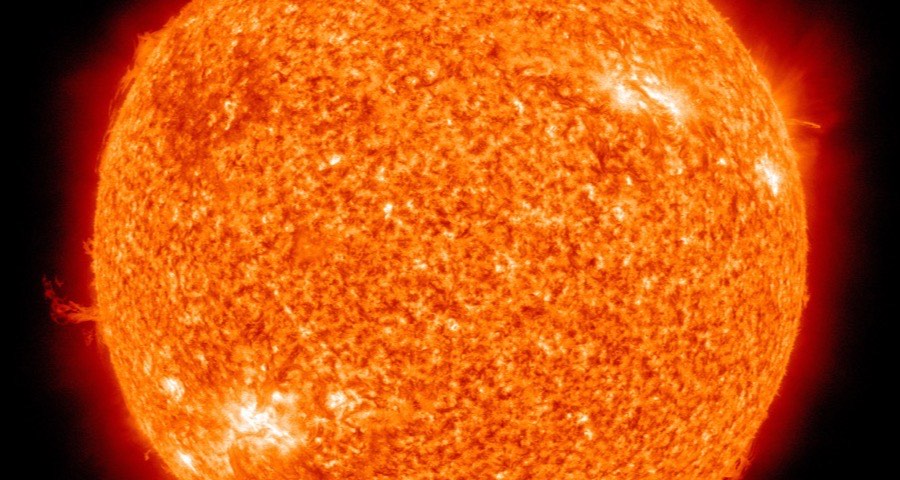
The Sun
99.86% of the total mass of the solar system is concentrated in a single place: our star. Everything else — planets, moons, asteroids, comets — fits within the remaining 0.14%.
Structure
At the heart of the Sun, the core reaches about 15 million degrees and a pressure high enough for hydrogen nuclei to fuse into helium — the reaction that produces all of the Sun's energy. This energy then takes tens of thousands of years to cross the surrounding radiative zone, bouncing from particle to particle, before reaching the convective zone, where the matter itself begins to circulate, like boiling water, to carry heat up to the visible surface.
Beyond this surface (the photosphere, at about 5,500°C) lies the solar corona — a tenuous atmosphere that is, paradoxically, far hotter, reaching several million degrees, visible to the naked eye only during total eclipses. The exact mechanism that heats the corona so far beyond the surface remains one of the great unsolved problems in solar physics.
Solar activity
The Sun is not a static body: solar flares release, within minutes, the energy equivalent of billions of nuclear bombs, while coronal mass ejections hurl billions of tons of plasma into space, sometimes toward Earth, where they disrupt radio communications and create spectacular auroras.
The Sun also constantly blows a solar wind — a continuous stream of charged particles that shapes the magnetosphere of every planet and marks the boundaries of the heliosphere, the bubble of the Sun's influence within the galaxy. Its activity follows a solar cycle of about 11 years, alternating between quiet phases and periods of intense activity marked by an increased number of sunspots.
A Sun with six faces
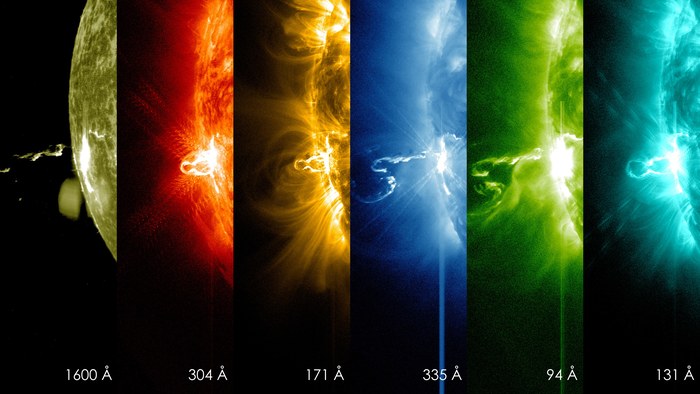
This series of images, captured at the same instant by the SDO (Solar Dynamics Observatory) observatory during an X4.9-class flare in 2014, shows the same event observed in six different ultraviolet wavelengths. Each wavelength, indicated in angstroms beneath each image, reveals a different layer of the solar atmosphere and a different temperature range — from the relatively "cool" photosphere (on the left) to the hottest regions of the corona (on the right), invisible to the naked eye and even in ordinary visible light.
This multi-wavelength approach is essential for understanding space weather: by combining these different views, scientists can track a flare's progression through the layers of the solar atmosphere and better anticipate the arrival on Earth of the particles and radiation it releases — a growing concern for protecting satellites and power grids.
Role in the solar system
The Sun's gravity is what holds all the planets, moons, asteroids, and comets in their orbits — without it, the solar system as we know it simply wouldn't exist. Its light and heat also define the habitable zone, the narrow region around it where water can exist in liquid form on a surface, and where, for now, only Earth is found.
The Sun is currently about halfway through its life, one star among hundreds of billions of others in the Milky Way — the subject is explored in more detail on the glossary's Stars page.
Nuclear fusion, the Sun's engine
At the Sun's core, nuclear fusion converts about 600 million tons of hydrogen into helium every second, through a chain of reactions called the proton-proton cycle. The mass difference between the starting nuclei and the final helium nucleus is converted into energy according to Einstein's famous equation, E=mc² — a tiny amount of mass per reaction, but repeated an incomprehensible number of times every second.
This energy, produced as gamma rays, actually takes tens of thousands of years to reach the Sun's surface, endlessly bouncing off particles in the radiative zone before escaping as visible light — a photon that reaches your eye today was therefore produced well before the invention of human writing. The Sun also releases billions of neutrinos every second, nearly massless particles that pass through the planet (and you) without interacting, and whose detection on Earth has directly confirmed the reactions taking place at the Sun's core.
The Sun's future
The Sun is currently roughly halfway through its existence as a main-sequence star, a stable phase expected to last about another 5 billion years. Once the hydrogen in its core is exhausted, it will begin fusing helium, swelling into a red giant whose radius could engulf Mercury, Venus, and perhaps Earth itself.
After this phase, the Sun will expel its outer layers as a planetary nebula — a glowing cloud of gas comparable to those observed around other dying stars — leaving behind a compact, extremely dense core: a white dwarf the size of Earth, which will then cool for tens of billions of years without ever fully going dark.