Structure of the System
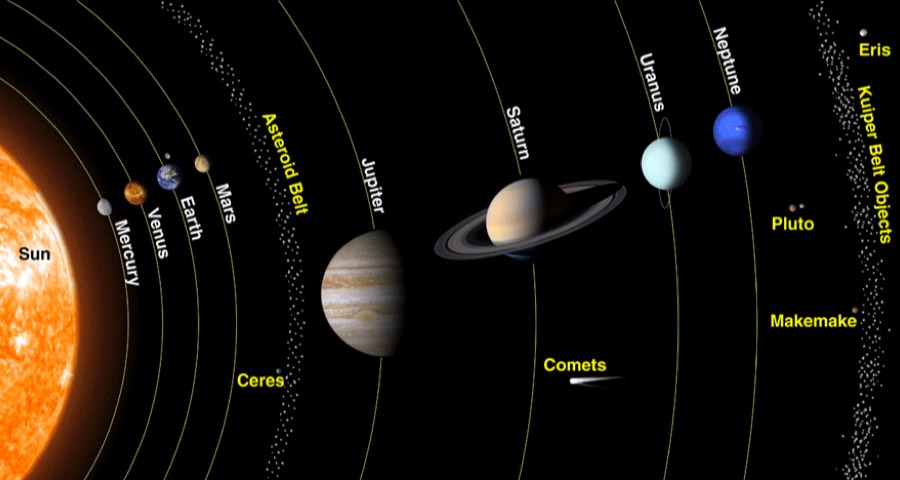
The solar system doesn't stop at Neptune: it stretches across distances that far exceed what any "to scale" view can show at once.
Inner system and outer system
Two broad regions are traditionally distinguished. The inner system, out to the asteroid belt, contains the four terrestrial planets — Mercury, Venus, Earth, and Mars — small, dense, and rocky, separated by relatively short distances. The outer system, beyond it, is home to the gas and ice giants — Jupiter, Saturn, Uranus, Neptune — far more massive but much less dense, spaced apart by distances measured in hundreds of millions of kilometers.
This separation is not arbitrary: it corresponds to the frost line, the distance from the Sun beyond which, during the system's formation, it was cold enough for water and other volatile compounds to freeze — explaining why the inner planets are rocky and the outer ones rich in gas and ice.
The asteroid belt
Between Mars and Jupiter lies the asteroid belt, a region populated by millions of rocky bodies that never managed to assemble into a planet, mainly because of the repeated gravitational disturbances from nearby Jupiter. Contrary to its portrayal in popular culture, this belt is far from crowded: the average distance between two asteroids of notable size is measured in millions of kilometers — plenty of room for a probe to pass through without any particular avoidance maneuver.
The Kuiper belt and the Oort cloud
Beyond Neptune begins the Kuiper belt, an icy ring far larger and far more populated than the asteroid belt, home to Pluto and several other dwarf planets, as well as countless small icy bodies — leftovers from the solar system's formation that never became part of a planet.
Further out still, at distances that could reach a light-year from the Sun, lies the hypothetical Oort cloud — a vast spherical shell of icy bodies, never directly observed but whose existence is inferred from the orbits of long-period comets, which appear to originate there. The Oort cloud would mark the true limit of the Sun's gravitational influence, far beyond anything a "to scale" view of the solar system can show at once.
An almost flat system
Seen from above, most planets, asteroids, and even many comets orbit roughly within the same plane, called the ecliptic plane — a direct consequence of the flattened protoplanetary disk they all formed from. Deviations from this plane generally remain small: less than 4° for most planets, with the notable exception of Mercury (7°).
Objects that stray far from this plane — certain long-period comets, or the dwarf planet Pluto, tilted at 17° — generally betray a different origin or a turbulent orbital history, such as a capture event or an ancient gravitational disturbance.
Moons, worlds in their own right
The solar system has more than 300 confirmed moons, with a diversity that rivals that of the planets themselves: some, like Ganymede or Titan, are larger than Mercury; others, like Phobos, are just captured chunks of rock a few kilometers across. Several icy moons — Europa, Enceladus, Titan, and possibly Triton — may harbor oceans of liquid water beneath their frozen crusts, making them priority targets in the search for extraterrestrial life, sometimes considered more promising than Mars itself.
Unlike planets, most large moons are in synchronous rotation with their planet: they take exactly as long to spin on their axis as they do to orbit, so they always show the same face to it — as is the case with our own Moon relative to Earth.
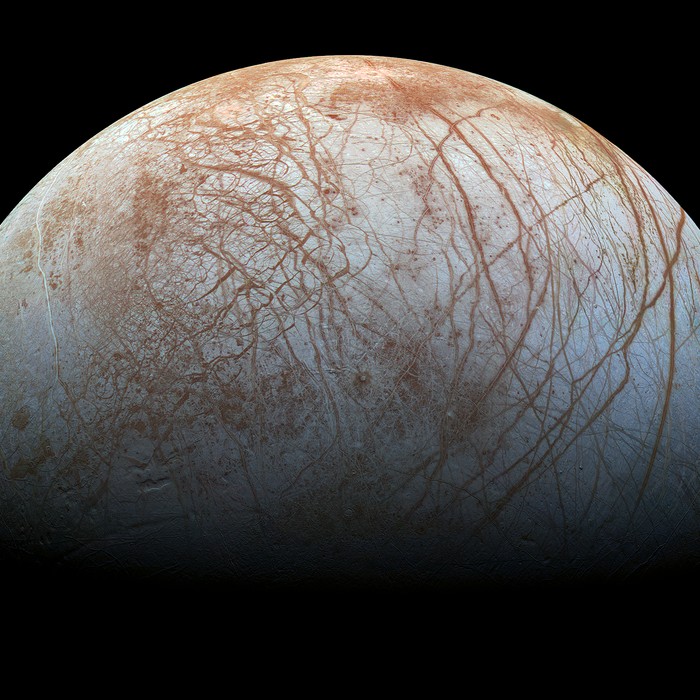
Europa, one of Jupiter's four large moons, alone illustrates why some satellites deserve to be studied as worlds in their own right. Its surface, one of the smoothest in the entire solar system, is crisscrossed by a dense network of reddish-brown fractures that betray intense past geological activity — probably caused by the movements of an ice crust floating above a global liquid ocean, kept molten by gravitational heating from Jupiter's tides rather than by sunlight, which is far too weak at that distance.
This subsurface ocean, estimated to hold more liquid water than all of Earth's oceans combined, makes Europa one of the most promising targets in the search for extraterrestrial life in the solar system — an issue important enough that NASA has dedicated an entire mission to it, Europa Clipper, currently en route to study its habitability potential more closely.