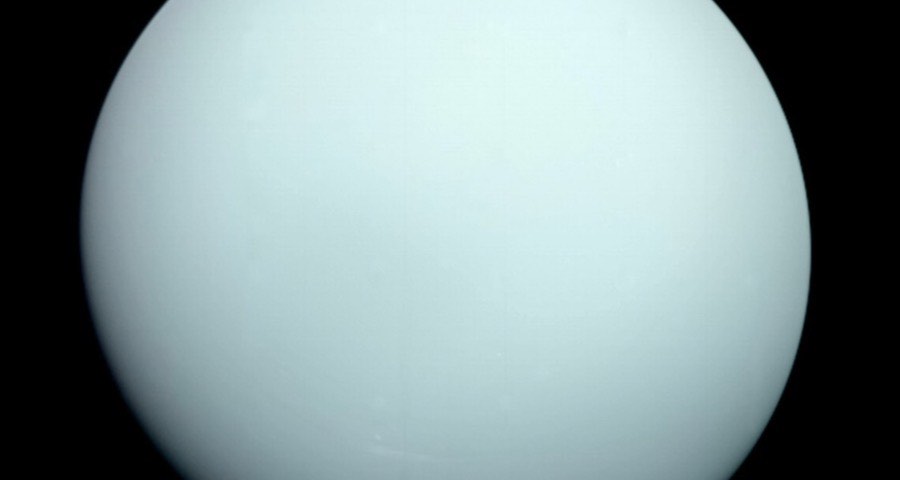
Uranus
The planet that rolls along its orbit instead of spinning upright — an anomaly still not explained with certainty.
Peculiarities
Every planet spins on an axis more or less vertical relative to its orbit — except Uranus, whose axial tilt reaches 98°. In practice, the planet spins almost on its side, like a ball rolling around the Sun rather than rotating normally. The most widely accepted hypothesis is a giant collision with an Earth-sized body early in the solar system's history, which would have literally knocked the planet onto its side.
This extreme tilt produces unique seasons: each pole experiences about 21 consecutive Earth years of uninterrupted sunlight, followed by just as many years of total night. Its pale blue-green color comes from atmospheric methane, which absorbs red light and reflects blue.
Ring system and moons
Uranus has a system of 13 known rings, dark and thin, discovered only in 1977 when astronomers observed the planet occulting a star. Unlike Saturn's bright, icy rings, those of Uranus are made of dark material, probably carbon-rich.
Its 27 known moons are named, uniquely in the solar system, after characters from the works of Shakespeare and Alexander Pope rather than Greco-Roman mythology — Titania, Oberon, Miranda, Ariel, and Umbriel are among the largest.
Miranda, the strangest moon in the solar system
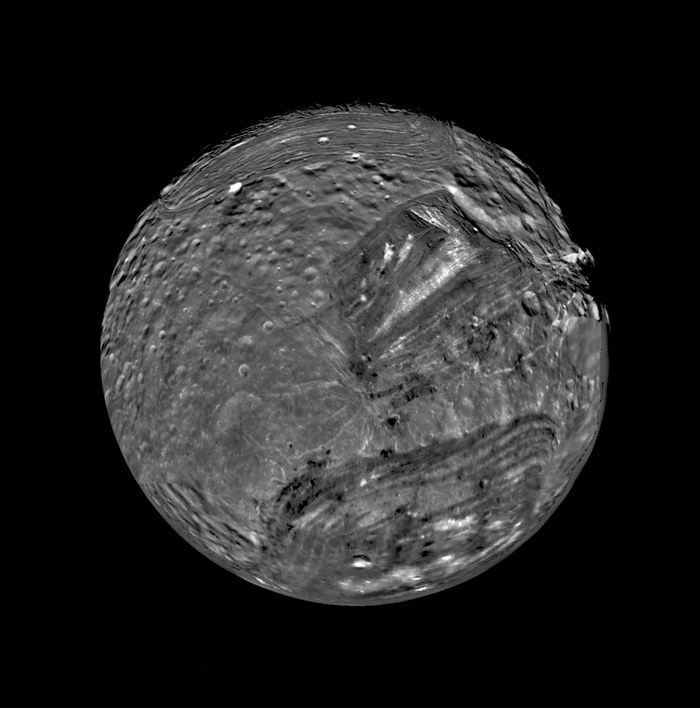
The smallest of Uranus's major moons at just 470 km across, Miranda nonetheless shows one of the most chaotic surfaces ever photographed in the solar system: dizzying cliffs, parallel grooves, and chevron-shaped geological formations that look like mismatched puzzle pieces stitched together. Its tallest cliff, Verona Rupes, may reach up to 20 km in height — one of the tallest known in the solar system, far more vertiginous than any escarpment on Earth.
The most commonly proposed explanation for this tormented landscape is that Miranda was shattered by a giant impact and then reassembled by gravity, its various internal layers ending up jumbled together in disorder — although alternative models point instead to unexpected internal geological activity for a body this small and cold. Only one probe, Voyager 2, has flown past Miranda, in 1986, leaving much of its surface still unexplored in detail today.
Exploration
Uranus has been visited only once, by the Voyager 2 probe, during a single flyby in January 1986. The few hours of close observation provided most of what we know today about its rings, its oddly tilted magnetic field, and several of its moons.
No dedicated mission has followed since, but Uranus now ranks among the stated priorities of the next generation of outer solar system exploration missions, including an orbiter concept being studied by NASA for the coming decades.
Internal structure
Uranus and Neptune form a category of their own, the ice giants, distinct from the gas giants Jupiter and Saturn. Beneath a thin envelope of hydrogen and helium, most of Uranus's volume is occupied by a thick mantle of water, ammonia, and methane — substances called "ices" in planetary science even though, under extreme pressure and temperature, they exist there in a fluid, conductive state rather than a familiar solid one.
This conductive, moving mantle is thought to generate Uranus's magnetic field — but that field is strangely tilted by nearly 60° relative to the planet's rotation axis, and offset from its core, unlike the well-aligned magnetic fields of Earth or Jupiter. The origin of this anomaly remains poorly understood.
A surprisingly cold planet
Uranus holds the record for the coldest planetary atmosphere in the solar system, with minimum temperatures approaching -224°C — colder than Neptune, despite being much farther from the Sun. This anomaly is partly explained by the fact that Uranus, unlike all the other giant planets, emits almost no internal heat of its own, for reasons still debated, possibly linked to the giant impact that tipped over its axis.
Recent observations from the James Webb Space Telescope have revealed fine cloud bands and richer atmospheric activity than expected, including around the pole currently facing the Sun — new data fueling interest in a dedicated mission.
Discovery
Uranus is the first planet discovered using a telescope rather than the naked eye — a turning point in the history of astronomy. William Herschel observed it in 1781 from his garden in Bath, England, initially believing he had discovered a comet. He first proposed naming it "Georgium Sidus" (George's Star) in honor of King George III, a name eventually dropped in favor of Uranus, for consistency with the Greco-Roman mythology used for the other planets.
This discovery instantly doubled the known size of the solar system and brought Herschel immediate recognition across scientific Europe.