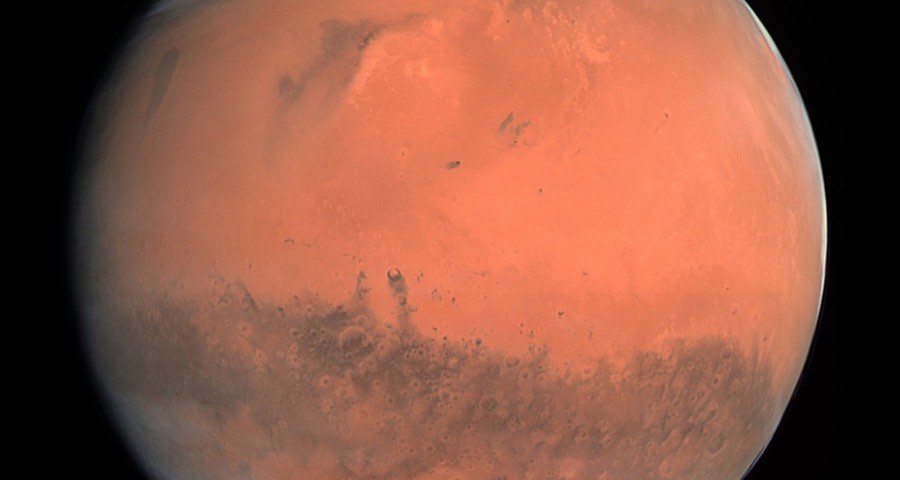
Mars
The red planet is as fascinating as it is puzzling: an icy desert today, but one that probably had rivers and lakes billions of years ago.
Physical characteristics
Mars owes its color to iron oxide — rust — which covers much of its surface. It is home to Olympus Mons, the largest known volcano in the solar system: about 22 km high, nearly two and a half times the height of Everest, with a base as wide as France. Its low gravity (about 38% of Earth's) allows geological structures to grow far taller than on Earth, since they don't collapse under their own weight.
Its polar caps, visible even through an amateur telescope, are made of permanent water ice covered each winter by a thin layer of dry ice that sublimates away in spring — a seasonal cycle that can be observed from one Martian year to the next.
Valles Marineris, the Martian Grand Canyon
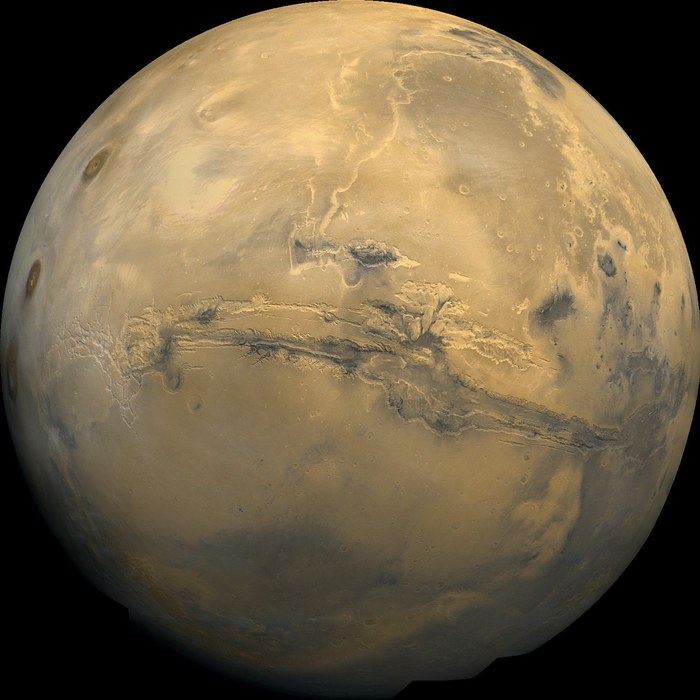
Visible here across the Martian disk, Valles Marineris is a canyon system so vast it would make Earth's Grand Canyon look tiny: about 4,000 km long, up to 200 km wide in places, and reaching a depth of 7 km — nearly ten times deeper than Arizona's Grand Canyon. Placed on Earth, it would span the entire width of the continental United States.
Unlike the Grand Canyon on Earth, carved gradually by a river's erosion, Valles Marineris formed mainly through tectonic fracturing: the Martian crust stretched and sank under the pressure of the nearby Tharsis volcanic bulge, which hosts Olympus Mons. Later erosion processes, including ancient water flows and massive landslides, then widened and deepened the initial canyon network.
Potential for habitability
Rovers and orbiters have gathered solid evidence of a much wetter past: dried-up riverbeds, minerals that only form in the presence of liquid water, and ancient deltas still visible at the bottom of craters like Jezero. About 3.5 to 4 billion years ago, Mars likely had a denser atmosphere and standing bodies of liquid water on its surface, before losing most of its atmosphere — probably stripped away by the solar wind, for lack of a global magnetic field to protect it.
Repeated but still debated detections of atmospheric methane intrigue scientists: this gas can have a geological origin, but also a biological one on Earth, making it a closely watched lead in the search for past or present life below the surface.
Exploration
Mars is the most explored planet after Earth: the rovers Sojourner, Spirit, Opportunity, Curiosity, and Perseverance have collectively traveled more than 80 kilometers across its surface, analyzing rocks and soil in detail. Perseverance is currently collecting samples intended to be returned to Earth by a future joint NASA/ESA mission.
Mars is also the stated target of the most serious crewed mission projects, pursued by both public space agencies and private companies — even though travel time, radiation, and the lack of a breathable atmosphere make it a technical challenge that remains largely unsolved.
Internal structure
The seismometer aboard the InSight mission (2018-2022), placed on the Martian surface, provided the first direct mapping of its interior by recording "marsquakes." The unexpected result: Mars has a core larger and more liquid than models had predicted, occupying more than half its radius, along with a crust surprisingly thick for a planet of its size.
Unlike Earth, Mars no longer has a global magnetic field today — but bands of fossil magnetism, preserved in certain ancient rocks of the southern hemisphere, prove it once had one billions of years ago, before its core stopped generating the dynamo effect.
Two small moons
Phobos and Deimos, Mars's two moons, are tiny (22 and 12 km in diameter) and irregularly shaped — they resemble captured asteroids more than true satellites, a hypothesis the Japanese MMX mission aims to verify by returning a sample of Phobos to Earth in the coming years.
Phobos orbits so close to Mars that it is slowly drawing nearer to the planet, and should, in about 50 million years, either crash into its surface or break apart to form a temporary ring around Mars.
Toward human exploration
Mars is the most seriously considered target for a future crewed mission beyond the Moon. The journey alone takes between six and nine months depending on the two planets' relative positions, exposing the crew to levels of cosmic radiation far higher than those experienced in low Earth orbit, given the lack of a protective atmosphere and magnetic field once on the surface.
Martian gravity, at only 38% of Earth's, also raises open questions about its long-term effects on the human body — an unknown that only extended stays will be able to resolve. Several projects, both public (NASA, ESA) and private (SpaceX with its Starship vehicle), aim for a first crewed flight to Mars within the coming decades, though with no firm date so far.
Global dust storms
Mars regularly experiences dust storms that can, in the most extreme cases, spread across the entire planet and last several weeks or even months. It was one such global storm, in 2018, that permanently disabled the solar-powered Opportunity rover by coating its solar panels in dust, ending a mission originally designed to last 90 days that ultimately ran for nearly 15 years.
These storms are amplified by Mars's low atmospheric density combined with sharp thermal contrast between sunlit and shadowed areas, a mechanism still being studied in detail to better anticipate them ahead of future crewed missions.
To observe Mars yourself
Mars's polar caps and its main dark surface features need a bit more magnification than you might expect — our guide details the right equipment to get started.
Which telescope should you choose to get started? →