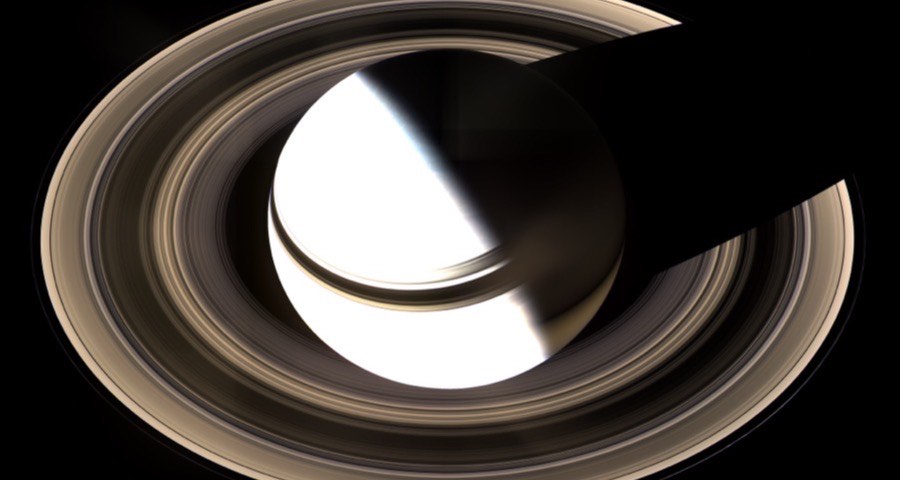
Saturn
The ringed planet, so low in density it would float on water — if you could find an ocean big enough to hold it.
Ring system
Saturn's rings are made of billions of fragments of water ice and rocky dust, ranging from grain-of-sand size to building-sized chunks, likely produced by the breakup of an ancient moon or a captured comet. Although they span about 280,000 km in diameter — three quarters of the Earth-Moon distance — their thickness never exceeds a few dozen meters anywhere.
The Cassini Division, a dark 4,800 km gap separating the two main rings A and B, is caused by a gravitational resonance with the moon Mimas, which periodically clears the region of particles. It is named after the Italian astronomer Jean-Dominique Cassini, who first observed it in 1675.
Notable moons
Titan, Saturn's largest moon, is the only satellite in the solar system with a dense atmosphere — thicker even than Earth's — and stable surface lakes, not of water but of liquid methane and ethane. Its rich organic chemistry makes it one of the most closely studied objects in the search for conditions favorable to life.
Enceladus, much smaller, shoots geysers of water vapor and ice particles from its south pole, revealing a liquid ocean beneath its frozen crust — the Cassini probe flew directly through these plumes and detected complex organic molecules within them.
Atmospheric characteristics
Like Jupiter, Saturn is a gas giant made mostly of hydrogen and helium, but its average density is so low (0.69 g/cm³) that it is the only planet in the solar system less dense than water. Its atmosphere is swept by equatorial winds that can exceed 1,800 km/h, among the fastest ever measured on a planet.
At Saturn's north pole, a strange hexagonal storm several times the diameter of Earth has persisted for decades — a stable geometric pattern whose exact origin is still debated.
The strange hexagon at the north pole
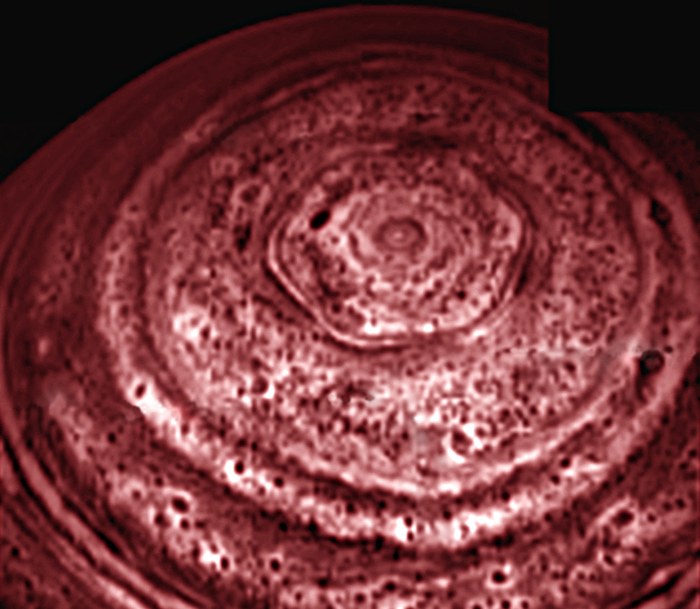
First spotted during the Voyager flybys in the early 1980s and later observed in detail for more than a decade by the Cassini probe, this near-perfectly regular six-sided pattern encircles Saturn's north pole across about 30,000 km — easily wide enough to fit several Earths side by side. Unlike an ordinary hurricane, the hexagon doesn't drift: its corners remain nearly stationary relative to the planet's rotation, an unusual stability for an atmospheric phenomenon.
Laboratory experiments, in which a ring of fluid rotating at different speeds spontaneously deforms into a polygon, suggest that this shape results from a jet stream circulating at very high speed around the pole. Color variations, from bluish to golden, have also been observed across Saturn's seasons, each lasting nearly seven Earth years, revealing an atmospheric photochemistry sensitive to sunlight.
Internal structure
Like Jupiter, Saturn hides beneath its clouds an interior that gradually shifts from gaseous hydrogen to liquid hydrogen, then to metallic hydrogen at depth, surrounding a probably rocky and icy core of about ten Earth masses. Its extremely low overall density stems from the proportion of hydrogen and helium, the lightest elements in the universe, which make up most of its volume.
Saturn also emits more energy than it receives from the Sun, but for a different reason than Jupiter: a rain of helium is thought to condense at depth and fall toward the planet's center, releasing heat through friction — a mechanism that would also explain why Saturn has lost proportionally more atmospheric helium than Jupiter.
Rings doomed to disappear
Data from the Cassini probe showed that Saturn's rings are slowly evaporating: the planet's gravity draws a continuous rain of electrically charged ice particles into its upper atmosphere, at a rate that could make the rings vanish within 100 to 300 million years — a mere instant on the timescale of the solar system.
This process also suggests the rings could be relatively young on a cosmic scale, perhaps only a few hundred million years old, rather than a leftover from Saturn's formation 4.6 billion years ago as once believed.
Exploration
After flybys by Pioneer 11 and the Voyager 1 and 2 probes between 1979 and 1981, the Cassini-Huygens mission (NASA/ESA) marked the golden age of Saturn exploration: in orbit from 2004 to 2017, it notably released the Huygens module, which landed on Titan in 2005 — the first successful landing in the outer solar system.
Cassini ended its mission with a deliberate, destructive plunge into Saturn's atmosphere in 2017, to avoid any biological contamination of Enceladus or Titan, two moons considered potentially habitable.
To observe Saturn yourself
Saturn's rings are visible from your own backyard with the right equipment — our guide details the minimum magnification needed and the best times to observe.
What equipment do you need to observe Saturn? →