Venus
Almost Earth's twin in size, Venus is nonetheless the most hellish place in the solar system — and it spins backward.
Physical characteristics
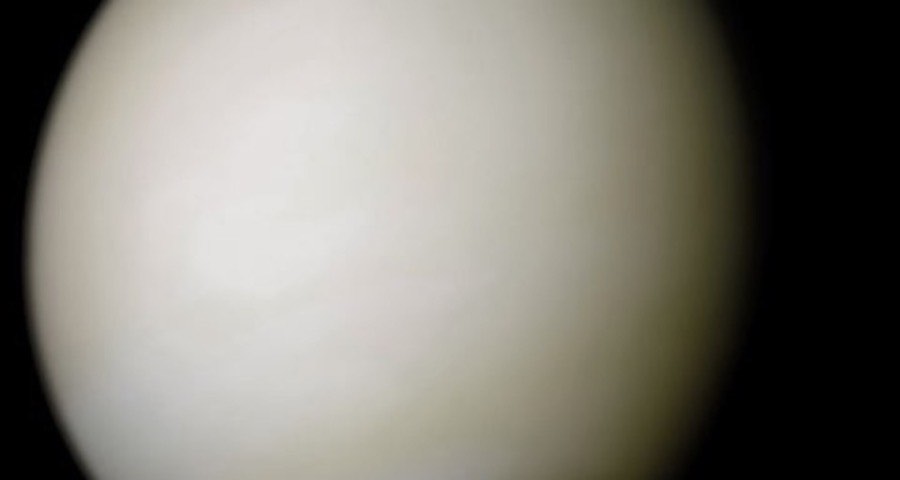
Venus is entirely covered by a thick layer of sulfuric acid clouds, which reflect sunlight and make the planet extremely bright in our sky — it is the "Evening Star." Beneath them, an atmosphere that is 96% carbon dioxide exerts a surface pressure equivalent to about 900 meters underwater on Earth, or 90 times Earth's atmospheric pressure.
This massive atmosphere produces a greenhouse effect so powerful that surface temperature reaches about 465°C — hotter than Mercury, even though Mercury is twice as close to the Sun. The heat stays permanently trapped, day and night, across the entire planet.
Peculiarities
Venus is one of only two planets in the solar system (along with Uranus) to spin on its axis opposite to its direction of orbit around the Sun — a retrograde rotation whose exact origin remains debated (an ancient collision, or the cumulative effect of atmospheric tides over billions of years). This rotation is also extraordinarily slow: a Venusian day lasts 243 Earth days, longer than its year (225 days)!
The crushing surface pressure and extreme heat make Venus one of the most hostile environments for direct exploration: the Soviet probes that landed there survived only a few dozen minutes before being destroyed.
Exploration
The Soviet Union dominated the exploration of Venus with its Venera program: Venera 7 was, in 1970, the first spacecraft to land on another planet and transmit data from its surface; several subsequent probes sent back the only photographs ever taken from the Venusian ground.
The American Magellan probe (1990-1994) mapped more than 98% of Venus's surface by radar, piercing through the planet's permanent cloud cover to reveal volcanoes, lava plains, and previously unknown tectonic deformations.
Internal structure
Venus is often called Earth's "twin": its size, mass, and internal composition are very similar, with a metallic core, a silicate mantle, and a rocky crust. Yet unlike Earth, Venus has no detected global magnetic field, even though its core is probably at least partially liquid. The most common hypothesis is that its extremely slow rotation isn't enough to sustain the dynamo effect that generates a magnetic field.
Without a magnetic field to protect it, Venus's atmosphere is directly eroded by the solar wind — a process that may have contributed, over billions of years, to the disappearance of a possible primordial ocean.
A hell beneath the clouds
Venus's sulfuric acid clouds produce rain that never reaches the ground: under the crushing heat, the droplets evaporate long before reaching the surface, a phenomenon called virga. On the ground, daylight takes on a diffuse orange hue, filtered through the thick atmosphere.
Recent data from the Magellan and Akatsuki probes, along with the detection of phosphine in the clouds (whose origin remains debated), have revived the hypothesis of active volcanism on Venus today — which would make it one of the few geologically alive bodies in the solar system, alongside Earth, Io, and Enceladus.
Maat Mons and radar mapping
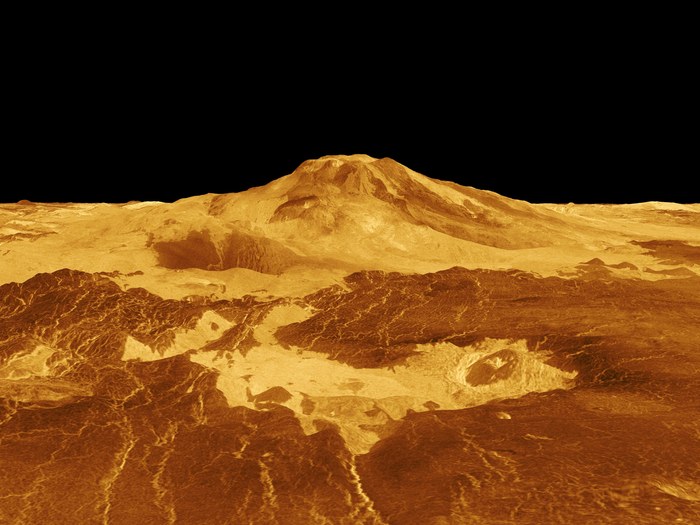
Since Venus's thick cloud cover completely blocks visible light, its entire surface had to be mapped by radar rather than conventional photography. It was the Magellan probe (NASA), in orbit from 1990 to 1994, that produced the first complete, detailed radar map of the planet, revealing a landscape dominated by volcanoes, lava flows, and basalt plains that are relatively young on a geological scale.
The image shown here, a 3D perspective reconstruction generated from that radar data (the orange tones are artificial, based on the few images taken at ground level by the Soviet Venera probes), shows Maat Mons, Venus's tallest volcano at about 8 km in elevation. Although its current activity remains uncertain, its surface carries lava flows that appear geologically very recent, reinforcing the hypothesis of ongoing volcanism mentioned above.
The twin that went wrong
Venus and Earth formed from the same nebula, at nearly identical sizes and masses — hence the nickname "twin planet." Yet their fates diverged radically: while Earth kept stable liquid water and a temperate climate, Venus fell into a runaway greenhouse effect that boiled away and ultimately destroyed its oceans billions of years ago, letting hydrogen escape into space and concentrating the remaining carbon into an ever-thickening atmosphere.
This catastrophic scenario, closely studied by climate scientists, now serves as a textbook case for understanding the limits of planetary habitability — and the exact role of distance from the Sun in this tipping point remains an active area of research, notably to assess the theoretical risk of a comparable phenomenon on Earth over the very long term.
Observing Venus from Earth
After the Moon, Venus is the brightest natural object in the night sky, sometimes visible in broad daylight to the naked eye for those who know where to look. Its phases, similar to the Moon's, were first observed by Galileo in 1610 — decisive evidence that Venus orbits the Sun rather than the Earth, supporting Copernicus's heliocentric model.
The rare transits of Venus across the solar disk, which occur in pairs separated by more than a century, were long used by 18th- and 19th-century astronomers to calculate the Earth-Sun distance with unprecedented precision for the time. The next transit won't occur until 2117.