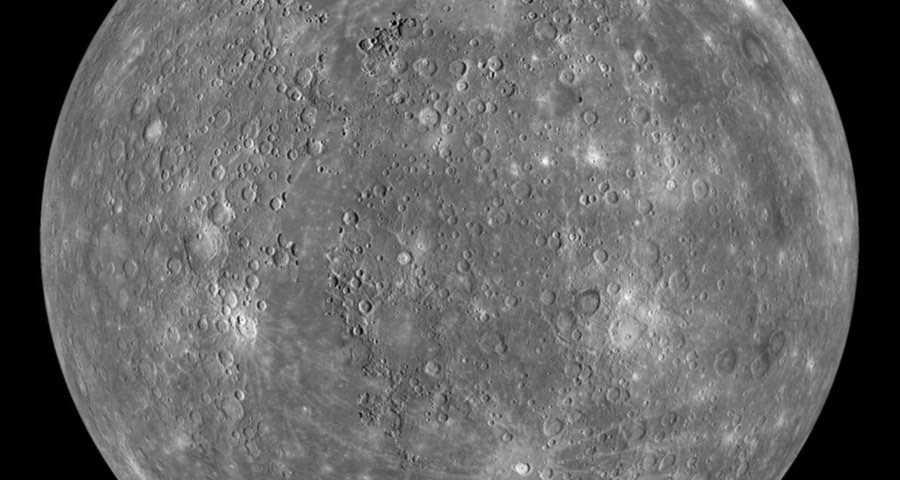
Mercury
The smallest planet in the solar system, and the closest to the Sun — a world of craters and extremes, with no atmosphere at all to cushion anything.
Physical characteristics
At just 4,879 km in diameter, Mercury is smaller than some moons in the solar system, such as Ganymede or Titan. Yet it has a density almost as high as Earth's, a sign of a proportionally enormous metallic core that may account for up to 85% of its radius — likely the remnant of an ancient collision that stripped away much of its rocky mantle.
Mercury has virtually no atmosphere: its gravity is too weak and its proximity to the Sun too aggressive to retain gases for long. With no air to redistribute heat, its surface resembles the Moon's — a static, grey crust riddled with impact craters billions of years old.
Orbit and rotation
Mercury completes its orbit around the Sun in just 88 Earth days, but spins very slowly on its axis. The two motions are locked in a 3:2 orbital resonance — unique in the solar system — the planet completes exactly three rotations on its axis for every two orbits around the Sun, a balance imposed by solar tidal forces over billions of years.
The result: a full solar day on Mercury (from one sunrise to the next) lasts the equivalent of 176 Earth days — twice its year. Combined with the lack of atmosphere, this produces the most violent temperature swings in the solar system: over 430°C in full daylight, down to -180°C at night, an amplitude of more than 600 degrees on a single planet.
Exploration
Only two probes have visited Mercury up close. Mariner 10 (NASA), in 1974-1975, managed to photograph only about 45% of its surface across three flybys. It took the MESSENGER probe (NASA), in orbit from 2011 to 2015, to obtain complete mapping — notably revealing water ice surprisingly present at the bottom of polar craters, permanently shielded from sunlight.
The European-Japanese BepiColombo mission, launched in 2018, is set to enter orbit around Mercury in 2026 with two separate orbiters, to study its magnetic field and internal composition in greater detail.
Internal structure
Beneath its thin rocky crust, Mercury hides a disproportionate metallic core: about 85% of its radius, compared to only 55% for Earth. Data from the MESSENGER probe showed it is at least partially liquid — a surprise, since a body this small should have cooled and fully solidified long ago. This moving core also generates a weak global magnetic field, one of the few among terrestrial planets alongside Earth's.
The leading hypothesis to explain this oversized core is a giant impact shortly after Mercury's formation, which would have stripped away much of its outer rocky mantle, leaving the metallic core proportionally far more massive than normal.
A shrinking planet
As it has slowly cooled since its formation, Mercury's core has contracted, causing the entire planet to wrinkle like a drying apple. This contraction created lobate scarps ("rupes"), long cliffs reaching several hundred kilometers in length and up to a kilometer in height, visible all over its surface.
Estimates suggest Mercury's radius may have shrunk by several kilometers since its formation — and that this process could still be continuing today, at an extremely slow pace.
History of observation
Mercury has been known since antiquity, but its proximity to the Sun makes it hard to observe: it never strays more than 28° from the solar disk in the sky, and is only visible briefly at twilight, before dawn or after sunset. Greek astronomers even believed for a time that it was two different bodies depending on whether it appeared in the morning or evening — named Apollo and Hermes respectively.
Mercury is also historically famous for an orbital anomaly: a tiny precession of its closest point to the Sun (its perihelion) remained unexplained by Newtonian gravity. It was Einstein's general relativity, published in 1915, that finally provided the exact explanation — one of the first striking confirmations of the theory.