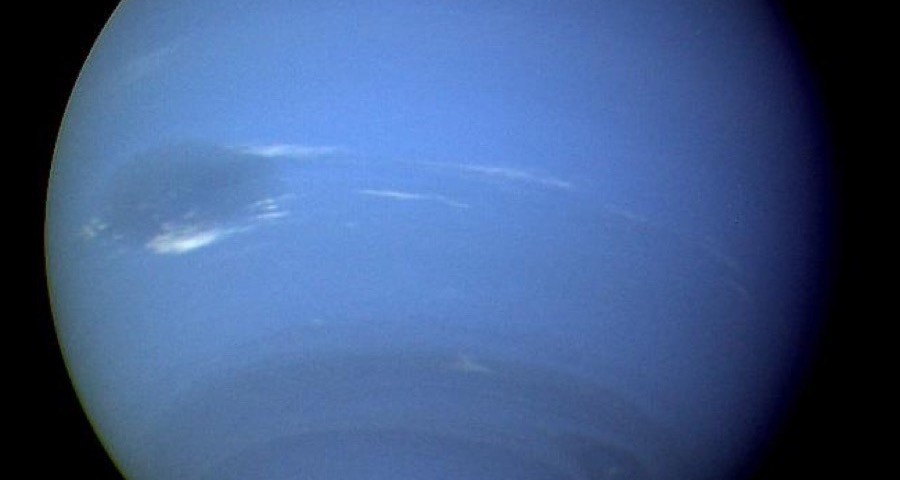
Neptune
The most distant planet of the official solar system, discovered not by observing it, but by calculating it.
Physical characteristics
Neptune owes its deep, saturated blue color to the methane in its atmosphere, which absorbs red light — a more intense blue than Uranus's, even though the two planets have very similar compositions, for reasons still poorly understood. It is an ice giant, a term describing a mantle rich in water, ammonia, and methane in the form of dense fluids, very different from the hydrogen and helium that dominate Jupiter and Saturn.
Neptune holds the record for the most violent winds ever measured on a planet in the solar system: up to 2,100 km/h, a supersonic speed, even though the planet receives only about 1/900th of the solar energy that Earth receives — a paradox suggesting an internal heat source that is still poorly explained.
Moons
Triton, its largest moon, is a special case: it is the only large satellite in the solar system to orbit retrograde, opposite to its planet's rotation — a strong clue that it is a captured object from the Kuiper Belt rather than one formed in place. Triton has active geysers of frozen nitrogen and a thin atmosphere, despite having one of the coldest surface temperatures in the solar system (about -235°C).
Neptune's 15 other known moons are much smaller and were mostly discovered only during the Voyager 2 flyby or thanks to modern telescopes.
Triton, a captured moon
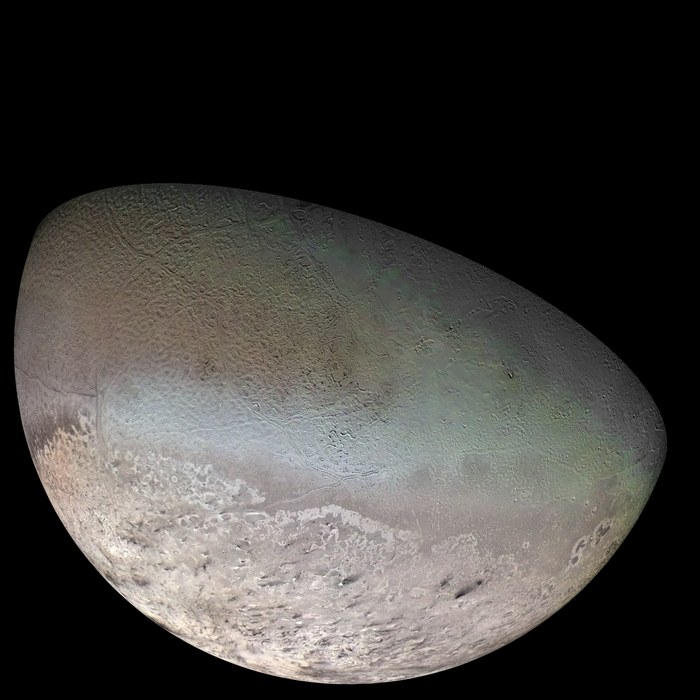
This mosaic, assembled from the best images taken by Voyager 2 during its single flyby in 1989, shows Triton's surprisingly young surface: few impact craters, but a so-called "cantaloupe terrain," streaked with ridges and depressions whose origin remains disputed, along with dark streaks thought to be traces left by its active nitrogen geysers, swept along by high-altitude winds.
Its retrograde rotation is not explained by formation in place around Neptune, but by gravitational capture: Triton is thought to be a former Kuiper Belt object, similar to Pluto in size and composition, trapped by Neptune's gravity billions of years ago. This capture mechanism would have generated enough heat through tidal friction to temporarily melt the moon's interior, explaining its geologically young surface despite its ancient origin. Over the very long term, tidal forces continue to slowly draw Triton closer to Neptune, a trajectory that will lead it, billions of years from now, to either break apart into a new ring or crash into the planet.
Discovery and exploration
Neptune is the only planet in the solar system discovered by mathematical prediction rather than direct observation: in the 19th century, astronomers noticed that Uranus's orbit showed slight, unexplained irregularities. Calculating these perturbations, carried out independently by Urbain Le Verrier and John Couch Adams, made it possible to predict the position of a still-unknown planet — Neptune was indeed observed in 1846, within less than a degree of the calculated position.
Like Uranus, Neptune has been visited only once, by Voyager 2 in August 1989, during the mission's final major planetary flyby before it left the plane of the solar system.
Internal structure
Like Uranus, Neptune is made up of a thick mantle of dense fluids — water, ammonia, and methane held at high pressure and high temperature — surrounding a probably rocky core roughly the size of Earth. This mantle, partly electrically conductive, generates a magnetic field that is likewise strongly tilted and offset from the planet's core, much like Uranus's — a shared trait that clearly sets the two ice giants apart from the gas giants Jupiter and Saturn.
Unlike Uranus, Neptune radiates about 2.6 times more energy than it receives from the Sun, an internal heat source whose exact origin remains debated — perhaps residual gravitational contraction, or ongoing radioactive decay in its core.
A little-known ring system
Neptune, too, has a system of rings, thin and dark, discovered during the Voyager 2 flyby in 1989. They are named after astronomers who contributed to its discovery: Le Verrier, Adams, Lassell, and Galle. One of them, the Adams ring, features strange concentrations of matter called "arcs," whose stability is explained by the gravitational influence of a small nearby moon, Galatea.
Too thin and too dark to be observed from Earth before the space age, these rings illustrate just how much Neptune remains, even today, the least well-known planet of the official solar system.
A first trip around the Sun since its discovery
With an orbital period of nearly 165 Earth years, Neptune only completed its very first full orbit since its discovery in 2011 — a cosmic "anniversary" closely followed by astronomers worldwide, since no one alive at the time of its discovery could witness it.
A dedicated mission, named Trident, had been proposed to NASA to visit Neptune and Triton in the 2030s; although not selected in the 2021 competition, it reflects growing scientific interest in returning to the ice giants, which have remained largely unexplored since Voyager 2.