BepiColombo
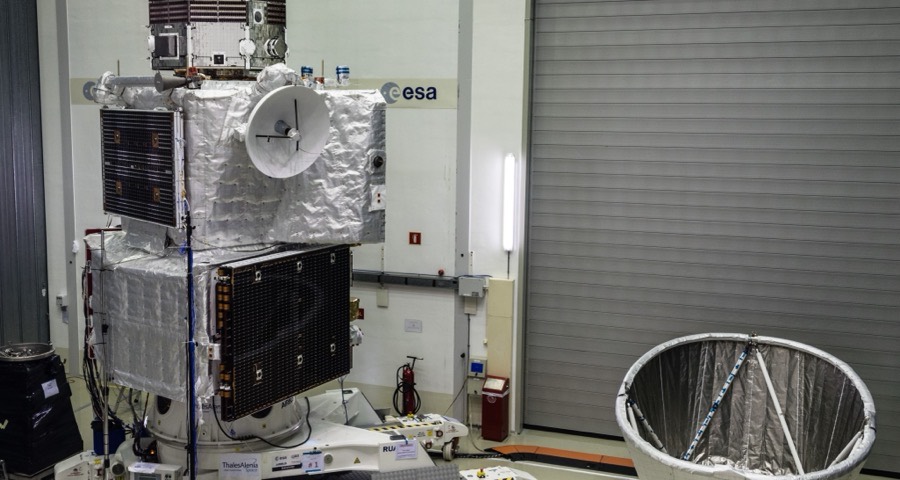
A joint mission of the European Space Agency (ESA) and the Japanese space agency (JAXA), BepiColombo is actually carrying two separate orbiters to Mercury — the least explored planet in the inner solar system.
See its current position in the 3D experience →Two spacecraft in one
Launched on October 20, 2018, from Kourou, BepiColombo is not a single spacecraft but a stack of three modules traveling together: the Mercury Planetary Orbiter (MPO), designed by ESA to study the planet's surface and interior; the Mercury Magnetospheric Orbiter (MIO), designed by JAXA to study its magnetic field and particle environment; and the Mercury Transfer Module (MTM), an electric propulsion module that powers and steers the whole stack until arrival. The mission is named after Giuseppe "Bepi" Colombo, the Italian mathematician who first worked out the complex orbital mechanics needed to reach Mercury efficiently.
A seven-year journey slowed down by gravity
Reaching Mercury is, paradoxically, one of the most energy-expensive maneuvers in the entire solar system: the Sun's proximity continually accelerates any spacecraft approaching it, and enormous braking is needed to settle into orbit rather than simply flash past at full speed. BepiColombo uses a combination of continuous ion propulsion and nine successive gravity assists — one flyby of Earth, two of Venus, and six of Mercury itself — to gradually shed speed over a seven-year journey.
During its flybys of Mercury, the spacecraft has already sent back close-up images of its cratered surface, helping refine the mission's scientific preparation even before final orbital insertion.
A "selfie" 295 km from Mercury
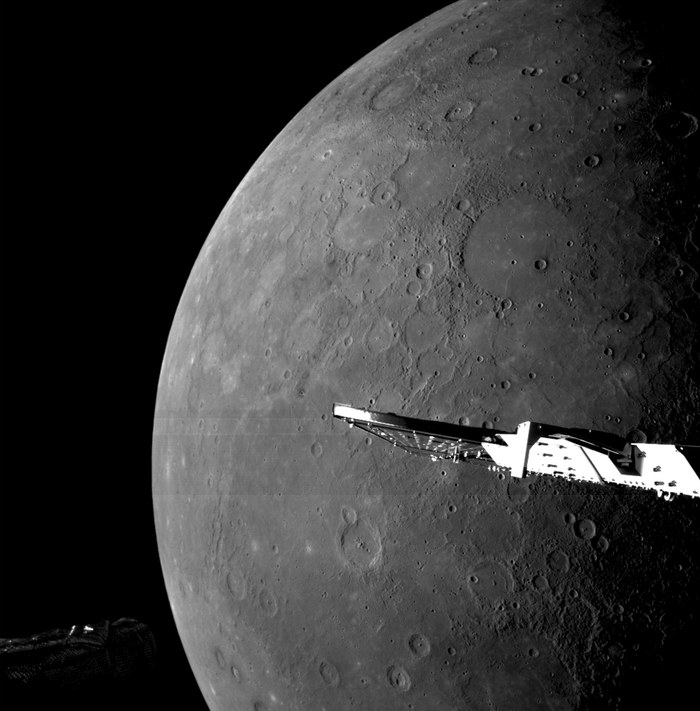
This image, taken on January 8, 2025, by one of the monitoring cameras onboard the transfer module, shows BepiColombo's own solar panel silhouetted against Mercury's crater-riddled surface — a genuine space "selfie" captured during the planet's sixth and final flyby before final orbital insertion. The spacecraft passed just 295 km above the surface at that point, its closest approach of the entire mission.
These monitoring cameras, originally intended to verify the correct deployment of the solar panels and antennas after launch, turned out to be an unexpected source of public-facing images: modest in resolution (1024 × 1024 pixels, black and white), they have nonetheless captured some of the mission's most memorable views, combining the spacecraft's own structure and Mercury's moon-like landscape in a single frame.
Studying the least explored planet
Only two missions had visited Mercury before BepiColombo: Mariner 10, which made three flybys in the 1970s, and MESSENGER, which orbited it from 2011 to 2015. BepiColombo is expected to bring unprecedented precision to several lingering mysteries: the exact composition of its dark, sulfur-rich surface, the origin of its oversized metallic core, which occupies about 85% of its radius, and the structure of its magnetic field — surprisingly present even though the planet's very slow rotation should, in theory, make it hard to sustain.
Both orbiters will also study the presence of water ice in permanently shadowed polar craters, never reached by direct sunlight despite the star's extreme proximity.
Two orbiters, two opposite designs
Europe's MPO and Japan's MIO don't just study different aspects of Mercury: they're designed on almost opposite principles. The MPO is three-axis stabilized, like most modern satellites, letting it point its instruments precisely at a fixed target. The MIO, smaller and cylindrical, is instead spin-stabilized — it rotates about fifteen times per minute, a simpler and more robust technique historically inherited from the very first satellites, particularly well suited to magnetic field measurements, which benefit from this steady spin to separate the real signal from instrumental noise.
This difference in design reflects the division of roles between the two agencies: ESA prioritized the versatility of a general-purpose orbiter, while JAXA optimized its own for a single family of measurements — those of the magnetosphere.
Arrival expected in late 2026
Once they arrive at their destination, the MTM transfer module will be jettisoned, and the two scientific orbiters will separate to occupy distinct polar orbits around Mercury, tailored to their respective instruments. Final orbital insertion is planned for late 2026, after which the actual science mission can begin, for a nominal duration of at least one Earth year — roughly four Mercury years.