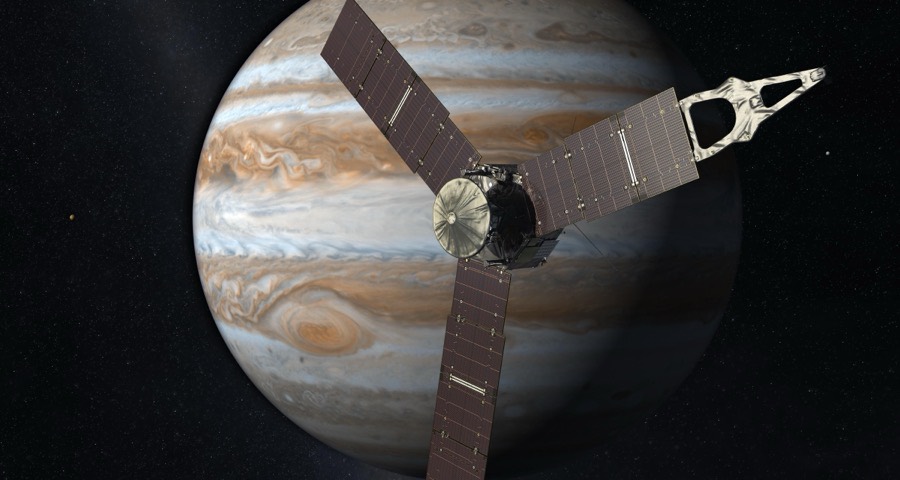
Juno
Since July 2016, Juno has traced an extremely elliptical polar orbit around Jupiter, diving to within just a few thousand kilometers of its cloud tops on each pass to uncover the secrets of what lies beneath.
See its current position in the 3D experience →An orbit designed to avoid radiation
Launched in August 2011, Juno reached Jupiter five years later, on July 4, 2016. Rather than a classic equatorial orbit, the mission adopted a highly elliptical polar trajectory, which brings the spacecraft close to the planet on each pass before swinging it far away again. This choice wasn't purely scientific: Jupiter has the most powerful magnetic field in the solar system, generating radiation belts so intense they would quickly destroy the electronics of a spacecraft orbiting nearby for extended periods.
By moving fast and pulling away again right after each close pass, Juno limits its cumulative radiation exposure. Its most sensitive electronic components are also shielded inside a titanium "vault" about one centimeter thick — a first for an interplanetary mission.
What Juno revealed beneath the clouds
Juno's instruments, particularly its microwave radiometer, can probe Jupiter's atmosphere far deeper than telescopes can observe in visible light. The spacecraft revealed that the planet's core is larger and more diffuse than expected, partially dissolved into the surrounding metallic hydrogen envelope rather than sharply defined — a discovery that forced a revision of models of Jupiter's formation.
Juno has also mapped the cyclones swirling at the planet's two poles, arranged in unexpected geometric patterns: eight cyclones in an octagon at the north pole, five in a pentagon at the south pole, stable since the mission began. Its measurements also showed that Jupiter's characteristic wind bands extend far deeper into the atmosphere than previously thought, down to about 3,000 km below the visible clouds.
The north pole's octagon of cyclones
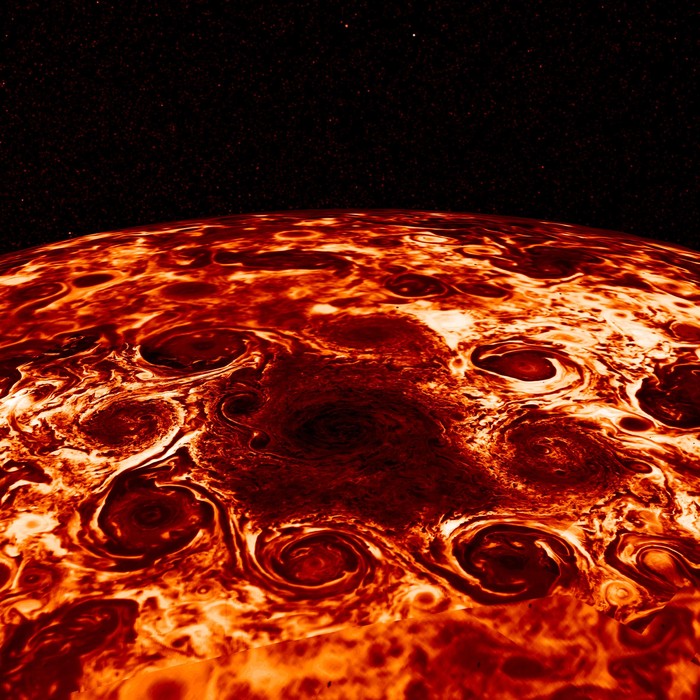
This false-color image, captured in infrared light by the JIRAM (Jovian Infrared Auroral Mapper) instrument, reveals the heat radiated by Jupiter's interior through the clouds at the north pole — the brightest hues correspond to the hottest areas, where cloud cover is thinnest. It allowed scientists to discover, as early as the mission's first polar flybys in 2016, a completely unexpected arrangement: eight massive cyclones arranged in an almost perfect circle around a ninth, central cyclone, each thousands of kilometers wide.
What intrigues researchers most is the stability of this configuration: contrary to what models predicted, these cyclones don't merge despite their proximity, but instead seem to push against one another to maintain an almost perfect geometric balance, year after year since Juno's observations began — a fluid-dynamics behavior still poorly understood, which scientists are trying to reproduce in the lab and through simulation.
A mission extended to the Galilean moons
After meeting its original objectives at Jupiter itself, Juno's mission has been extended several times, with a broadened goal: the close study of the Galilean moon system. The spacecraft made a close flyby of Europa in September 2022, gathering data on the ice crust of this moon, which likely harbors a liquid water ocean, followed by a flyby of Io in 2023–2024, the most volcanically active moon in the solar system.
These flybys complement data gathered decades earlier by the Galileo mission, now with far more modern instruments.
The farthest solar-powered spacecraft ever sent
Unlike most missions to the outer solar system, which rely on nuclear generators, Juno runs entirely on solar power — a bold technical choice at a distance where the Sun appears about 25 times dimmer than it does from Earth. Its three solar panels, each over 9 meters long, rank among the largest ever deployed on an interplanetary spacecraft, yet produce only about 500 watts in orbit around Jupiter, compared to nearly 14 kilowatts the same panels would generate near Earth.
This technological gamble, made possible by high-efficiency photovoltaic cells developed specifically for the mission, made Juno the first solar-powered spacecraft to operate this far from the Sun — a feat that opens the way for future missions to the outer system without relying on plutonium, a resource that has become scarce and costly to produce.