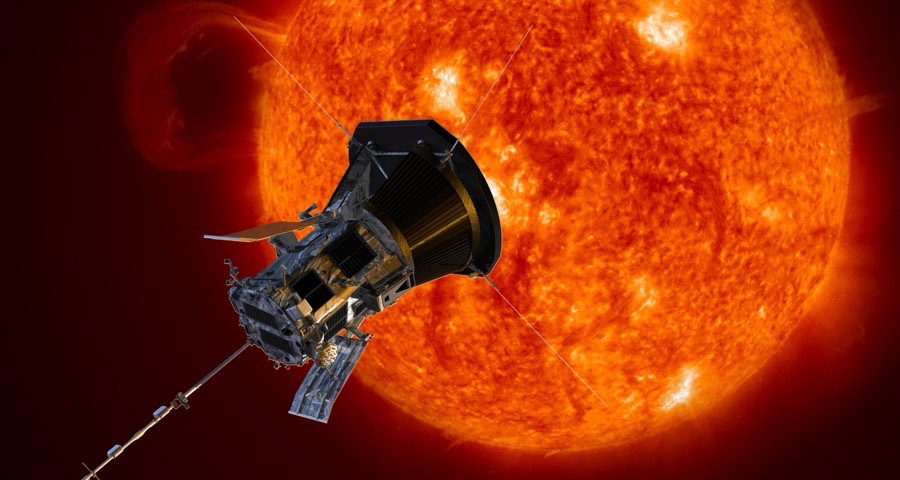
Parker Solar Probe
Launched in 2018, Parker Solar Probe is the first spacecraft to have literally "touched" the Sun, repeatedly plunging directly into its corona — our star's outer atmosphere.
See its current position in the 3D experience →A mission named after a living scientist
Launched on August 12, 2018, the spacecraft is named after Eugene Parker, the astrophysicist who predicted the existence of the solar wind — that continuous stream of charged particles emitted by the Sun — as early as 1958. It is the first NASA mission named in honor of a person still living at the time of launch; Eugene Parker attended the liftoff and passed away in 2022.
The mission's goal is to answer questions that have stood for decades: why is the solar corona, the Sun's outer atmosphere, hundreds of times hotter than its visible surface, and what accelerates the solar wind to supersonic speeds?
A heat shield to survive 1,400°C
To get this close to the Sun, Parker Solar Probe is protected by a heat shield 11.4 centimeters thick, made of two panels of reinforced carbon-carbon composite separated by insulating carbon foam. This shield, called the TPS (Thermal Protection System), withstands surface temperatures exceeding 1,400°C during its closest passes, while keeping the scientific instruments in its shadow at a comfortable ambient temperature of about 30°C.
The spacecraft is equipped with sensors that automatically detect any deviation in its orientation relative to the Sun, and can reorient itself within seconds to keep the shield pointed exactly at the star — a prolonged alignment error would be fatal to the mission.
The fastest object ever built
Each orbit gradually brings Parker Solar Probe closer to the Sun, thanks to a series of gravity assists from Venus that slow the spacecraft down and tighten its elliptical orbit. Carried by the Sun's intense gravity during its closest approaches, it reaches dizzying speeds: in December 2024, it exceeded 190 km/s (about 690,000 km/h), becoming the fastest object humanity has ever built — fast enough to cover the distance from Paris to New York in about thirty seconds.
During that same orbit, the spacecraft came within just 6.1 million kilometers of the Sun's surface, well inside Mercury's orbit, setting the record for the closest any human-made object has ever come to a star.
The closest images ever taken of the Sun
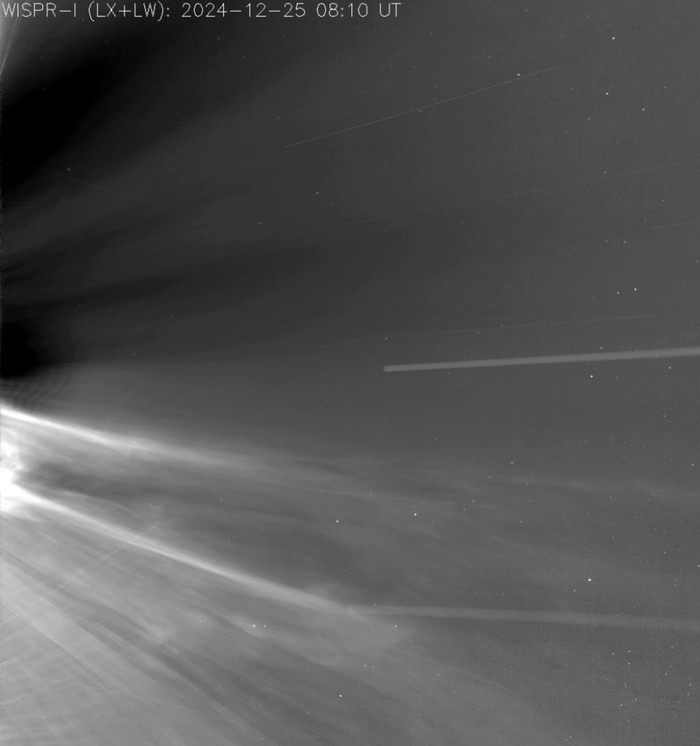
This raw image, captured by the WISPR (Wide-field Imager for Solar Probe) instrument on December 25, 2024, during the spacecraft's record flyby 6.1 million kilometers from the Sun, directly shows filaments of solar wind streaming out of the corona — the very region Parker Solar Probe was built to physically fly through. The fine lines visible in the image are traces left by interplanetary dust grains striking the sensor at high speed, a phenomenon now familiar to the mission team.
Unlike the spectacular, colorful images usually released by solar observatories in Earth orbit, this raw, grayscale view illustrates the reality of scientific work: it's data of this kind, patiently analyzed, that allows researchers to directly measure the structure and speed of the solar wind at its source, rather than inferring it indirectly from Earth's distance.
What Parker has discovered
By physically flying through the solar corona, Parker Solar Probe has observed "switchbacks" — sudden, temporary, zigzag-shaped reversals of the solar magnetic field, whose origin remains debated but which could play a key role in heating the corona and accelerating the solar wind. The spacecraft has also pinpointed the precise zone where the solar wind becomes supersonic, and has mapped the "dust-free zone" near the Sun, a region where intense heat vaporizes interplanetary dust grains.
The mission is set to continue at least through 2025, with orbits drawing ever closer to the Sun as its fuel runs low and its minimum altitude keeps dropping.
Why the Sun is so hard to reach
Counterintuitively, heading straight for the Sun is one of the most energy-expensive maneuvers in the entire solar system — far more so than leaving it entirely. Earth, and any spacecraft launched from it, is already moving at about 30 km/s around the Sun; to "fall" toward the star rather than keep orbiting it at that speed, nearly all of that sideways velocity has to be cancelled out — a fuel expenditure so large that no rocket today can deliver it in a single burn.
That's why Parker Solar Probe doesn't dive straight at the Sun at launch, but instead uses seven successive flybys of Venus, spread over several years, to very gradually slow its orbital speed and tighten its ellipse with each pass — the same gravity-assist logic used by the Voyager probes, but applied here to slow down rather than speed up.