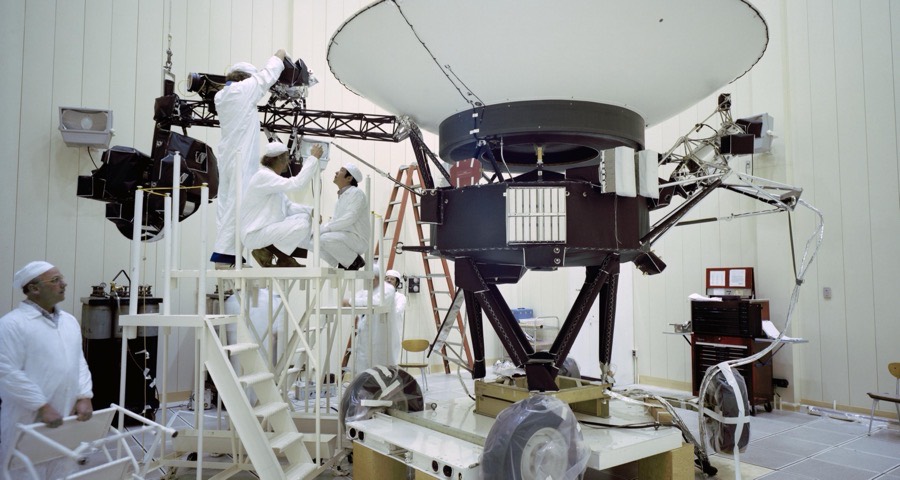
Voyager 2
Launched three weeks before its twin spacecraft, Voyager 2 achieved something no other craft has ever managed: flying past all four giant planets of the solar system in a single mission.
See its current position in the 3D experience →The "Grand Tour" of the four giants
Voyager 2 lifted off on August 20, 1977, on a slower trajectory than Voyager 1's, but ideally positioned to take advantage of an exceptional planetary alignment that occurs only about once every 175 years. This alignment allowed a single spacecraft to fly past Jupiter, Saturn, Uranus, and Neptune in succession, using each planet's gravity assist to reach the next without any additional fuel.
It flew past Jupiter in July 1979, then Saturn in August 1981. Unlike Voyager 1, its trajectory was kept within the ecliptic plane after Saturn, allowing it to continue on toward the next planets rather than diverting toward Titan.
The only spacecraft to have visited Uranus and Neptune
In January 1986, Voyager 2 became the first, and to this day the only, spacecraft to fly past Uranus. It discovered ten new moons and revealed a magnetic field surprisingly tilted 60° from the planet's rotation axis — an anomaly whose origin remains debated. Three years later, in August 1989, it flew past Neptune, the final stop on its Grand Tour, discovering the most violent winds ever measured in the solar system, exceeding 2,000 km/h, as well as the Great Dark Spot, a gigantic storm that has since vanished.
These two flybys remain, to this day, the only close observations ever made of these two ice giant planets — everything we know about them in detail comes from the few hours Voyager 2 spent in their vicinity.
Neptune's Great Dark Spot
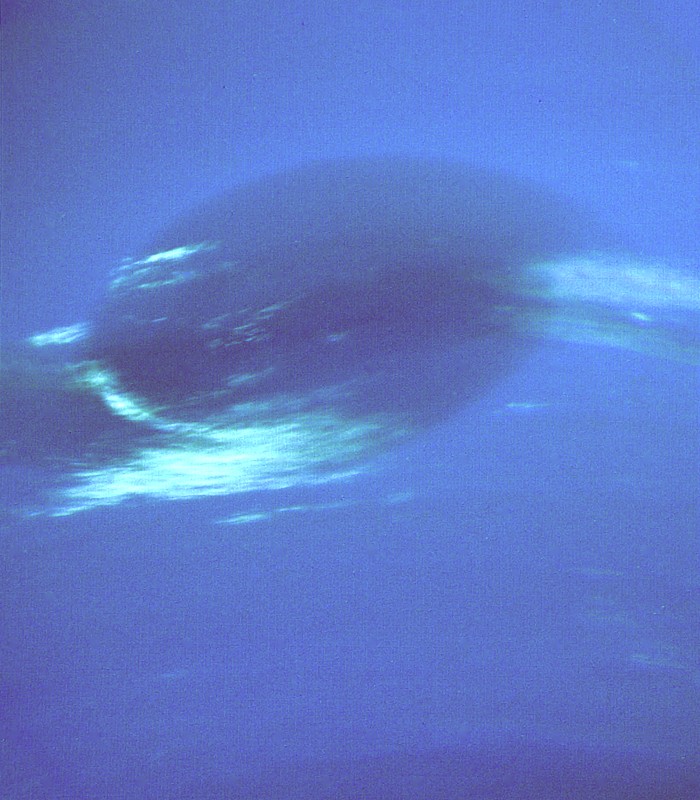
Discovered by Voyager 2 during its 1989 flyby, the Great Dark Spot was an anticyclonic storm system comparable in size to the entire Earth, seen here surrounded by streaks of bright methane clouds pushed along by the surrounding winds — the fastest ever measured on a planet in the solar system, exceeding 2,000 km/h. Its dark color was likely caused by a hole in the upper cloud layer, exposing deeper, darker layers of the atmosphere.
Remarkably, this storm was never seen again in later observations by the Hubble Space Telescope in the early 1990s: unlike Jupiter's Great Red Spot, stable for centuries, Neptune's Great Dark Spot had simply dissipated within a few years, before a new dark storm appeared elsewhere in the northern hemisphere — proof that the weather on ice giants can be far more changeable than that of gas giants.
Leaving the heliosphere
After Neptune, Voyager 2 continued outward through the solar system, on a trajectory directed south of the ecliptic — a different direction from its twin's. It crossed the heliopause on November 5, 2018, six years after Voyager 1, becoming the second human-made object to enter interstellar space. Unlike Voyager 1, Voyager 2 still carries a working plasma instrument, which yielded unique complementary data on this transition.
A mission extended under power constraints
More than 45 years after launch, Voyager 2 continues sending back data thanks to its radioisotope thermoelectric generators, whose output is steadily declining. In 2020, the mission team had to switch off one of the five remaining scientific instruments to conserve available power and keep the others running longer. An unexpected rebalancing of the electrical safety margin in 2023 pushed that deadline back: the mission could stay active until around 2030, before power becomes insufficient to run even a single instrument.
Like its twin spacecraft, Voyager 2 also carries a copy of the Golden Record, the gold-plated disc intended to bear witness to Earth's existence for any distant future discoverers.
A second look at interstellar space
Because Voyager 2 kept a working plasma instrument where Voyager 1's had failed years earlier, it was able to directly confirm, through a density measurement rather than indirect inference, the exact moment it left the heliosphere. Its data also revealed that the heliopause boundary is not perfectly spherical: Voyager 2 crossed it at a distance from the Sun slightly shorter than Voyager 1's, even though the two spacecraft were traveling in very different directions — a hint that the shape of the Sun's protective bubble is unevenly shaped by the surrounding interstellar medium.
In 2023, a commanding error temporarily misaligned the spacecraft's antenna, cutting off all communication for several days — an incident resolved remotely from Earth despite a round-trip radio delay of more than 37 hours, illustrating the precision still required to operate a craft nearly half a century old at such a distance.